



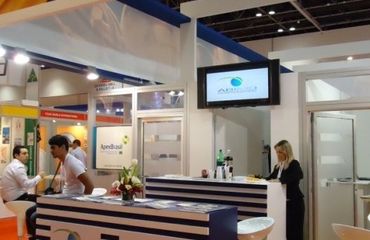
São Paulo – The new stage of six projects designed to promote Brazilian products abroad is expected to boost sales by close to 20% by the end of next year. An agreement signed by the Brazilian Export and Investment Promotion Agency (Apex-Brasil) and six sectorial organizations provides for nearly USD 31 million in investment, with exports fetching as much as USD 800 million in 2016. In 2014, the projects led to a combined USD 640 million in exports.
In three of the contracts renewed this month, Arab countries are priority markets or potential importers. These agreements are: Heating, Ventilation, Air Conditioning, Refrigeration Brasil, involving the Brazilian Refrigeration, Air Conditioning, Ventilation and Heating Association (Abrava); Brazilian Health Devices, of the Brazilian Medical Devices Manufacturers Association (Abimo); and Brazilian Rice, with the Brazilian Rice Industry Association (Abiarroz).
Three other projects do not include Arab nations among their potential markets: Pet Brasil, of the Brazilian Pet Products Industry Association (Abinpet); FilmBrazil, of the Brazilian Audiovisual Producers Association (Apro); and Brasil Foodservice, with the Brazilian Association of Food Equipment, Ingredients and Accessories Industries (Abiepan).
According to Apex export manager Christiano Braga, the new stage of the projects is more ambitious: “The goal for 2016 is to export up to USD 800 million worth of goods. It’s a more aggressive plan focusing on market diversification,” said Braga.
He said the “beacon” for export projects in Brazil is the National Exports Plan, introduced by the government in June to increase foreign sales. “The National Exports Plan is our beacon. It drives our trade promotion actions with an emphasis on diversification. The Arab countries are part of this diversification effort,” he said.
Abrava’s project led to USD 321.5 million worth of exports last year, with an expected USD 389 million in 2016. Priority markets include Latin American countries and the United States, as well as the United Arab Emirates and Russia.
According to the technical manager of the Abrava Exporta project, Leila Vasconcellos, the partnership with Apex-Brasil has been in place since 2004. In some of the project’s stages, the UAE were a priority target. The project’s member companies went to the Big 5 construction industry fair, in Dubai, and went on commercial missions to Dubai, Sharjah and Abu Dhabi, all of which are cities in the UAE.
“There is a demand for Brazilian products in the HVAC-R industry (heating, ventilating, air conditioning and refrigeration), with strong competition from companies from Asian countries,” said Vasconcellos. “For this stage of the project, we will monitor the market and keep track of the dynamics, and in case there’s a demand for the products and opportunities are available for the companies, we will work there again,” she said.
Abimo’s Brazilian Health Devices project includes Saudi Arabia among its priorities in the hospital-medical industry. In dentistry, the UAE and Saudi are primary targets. As per Apex data and forecasts, the program exported USD 122 million in products in 2014 and will shoot for USD 139.6 million in 2016. The Saudis are also among the priorities of the Brazilian Rice project.
The Apex has 76 trade promotion projects with various sectorial organizations, whereby its member companies go to international fairs and events in order to advertise and sell their products. The projects usually last two years and can either be renewed or not.
According to Braga, besides the National Exports Plan, the current exchange rate helps fuel exports. However, he said that in order to go international and become engaged in sectorial projects, companies must do their homework. “There really was an increase in number of contacts [from aspiring exporters] here at Apex-Brasil. We are diversifying our dialogue with new demographics and taking advantage of the favorable scenario. However, the companies that were already a part of our actions are surfing the exchange-rate wave better,” he said.
*Translated by Gabriel Pomerancblum
