


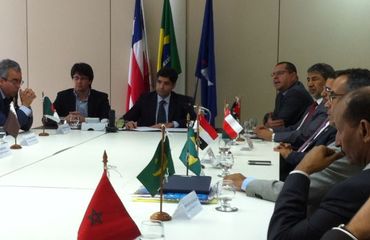
Salvador – Arab diplomats have proposed for the Brazilian petrochemical company Braskem to enter into a partnership with companies in the Middle East and North Africa in order to build a unit in the region. The suggestion was made this Wednesday (30th), during a visit of the Council of Arab Ambassadors in Brazil to Braskem’s unit at the petrochemical hub of Camaçari, in the state of Bahia.
The Brazilian company owns 36 manufacturing plants in Brazil, Europe, United States and one that is under construction in Mexico, but none is in an Arab country. The reasons include difficulties in finding low costs and large consumer markets in the region, said the production manager at Camaçari, Murilo Amorim.
“There already are strong companies and strong partnerships in the Arab industry, therefore our presence is not justified yet. The consumer market is not that large either. Many of the petrochemical companies active in the Middle East and Africa manufacture their products there and ship them back home,” Amorim said. He did say, however, that Braskem looks into the possibility of investing in the Arab countries whenever it enters a new project.
The Qatari ambassador to Brasília, Mohammed Al Hayki, said Arab companies may eventually co-invest alongside the Brazilian petrochemical company. “The company could become associated with a Qatari firm, and thus aim for partnership instead of competition.” The Kuwaiti ambassador, Ayadah Alsaidi, said companies in his country can also partner up with Braskem.
Braskem is Brazil’s leading petrochemical company, and retains approximately 70% of the country’s polypropylene market. Its annual revenues amount to R$ 42 billion, approximately US$ 8 billion of which originate from the foreign market. Even though it does not own a unit in the Arab countries, Braskem does sustain commercial relations with them. According to Amorim, the main raw material for Braskem is naphtha (an oil product), which it imports from countries in the Middle East and North Africa.
The company consumes roughly 4 million tonnes of naphtha each year, and imports 30% to 35% of it. The leading supplier of the product to Brazil is the state-owned company Petrobras, a minority stakeholder in Braskem, which is controlled by the Odebrecht conglomerate.
Mayor of Salvador
This Wednesday, aside from visiting the Camaçari petrochemical hub, the Arab diplomats met with the mayor of Salvador, Antônio Carlos Magalhães Neto. They proposed to create a house of Arab culture in the capital of the state of Bahia. Three diplomats, from Oman, Algeria and Palestine, suggested making Salvador a “sister city” with their countries’ capitals, which would enable for experiences in public management projects to be exchanged.
Magalhães endorsed the two proposals, and also said he would like to partner up with Arab countries in expanding the city of Salvador. He said he plans on raising the share of the budget allotted to investment in the city from 2% to 18%. “We are preparing a business agency whose aim will be to attract investment, especially into tourism, non-pollutant industries, and technology,” he said.
The Arab diplomats’ visit to Bahia was sponsored by the Council of Arab Ambassadors in Brazil and the Arab Brazilian Chamber of Commerce, which conduct frequent missions to different states in Brazil. In 2013, the diplomats have travelled to Goiás and Rio Grande do Sul.
To the Council’s dean, Palestine’s Ibrahim Alzeben, the meetings held this Wednesday have been fruitful, and may yield positive results in the future. “The ambassadors enjoyed the meeting at the petrochemical company, where they discussed possibilities of exchange and of the company expanding into where the raw material (for the products it makes) is. With the mayor of Salvador, we have succeeded in establishing a partnership and paving the way to becoming sister cities, and we have also discussed eventually setting up the House of Arab Culture,” Alzeben said.
Next Thursday (31st), the ambassadors will attend the Economic Forum of Bahia-Arab Countries, to be held at the Federation of Industries of the State of Bahia (FIEB). They will also meet with state governor Jaques Wagner. The delegation visiting Bahia comprises the Arab Brazilian Chamber CEO, Michel Alaby, the ambassadors of Palestine, Kuwait, Qatar, Tunisia, Oman, Algeria, Egypt, Sudan and the Arab League, as well as the charges d’affaires from the embassies of Saudi Arabia, Jordan, Mauritania and Morocco, and the diplomat in charge of the Middle East at the Brazilian Foreign Office, Carlos Leopoldo.
*Translated by Gabriel Pomerancblum
