



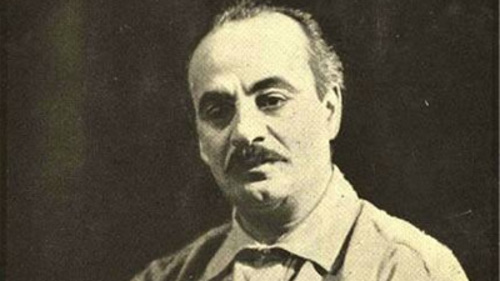
São Paulo – Starting on May 3, Brazilians may see paintings, manuscripts, letters, documents, original notebooks and even personal objects of Lebanese philosopher, poet, painter and enthusiast Gibran Khalil Gibran. An exhibition at the Latin American Memorial should show the items, brought straight from Gibran Museum, in Bicharré, Lebanon. According to Lody Brais, the president of the Brasil-Lebanon Cultural Association, which organises the fair, this is the first time the material will be shown in Latin America.
The Brazil-Lebanon Cultural Association is promoting the exhibition alongside Gibran National Committee and Gibran Museum. The organisation’s objective is to rescue Lebanese culture in the country and tends to work on themes that unite Brazil and Lebanon. “Gibran is of worldwide renown,” said Brais. He believes that the fair should attract all kinds of audiences, not just those who already admire the work of the Lebanese, but also new ones, who will have at the event an opportunity to learn about him. For this, the association is promoting the event at schools and universities.
Participation in the exhibition has been taking place since 2011. The organisation promoted another event, in 2008, to celebrate the 125th anniversary of the birth of Khalil Gibran. The exhibition at the Latin American Memorial is celebrating the 130th anniversary of the birth of the poet, who was born in 1883 and died in 1931, at 48 years of age.
Bicharré, where Gibran Museum is located, is the birthplace of the writer. Khalil, his mother and brothers moved to the United States when he was a child, but he returned to his country to study and then lived in France for a while, to progress with his art training. But it was mostly in New York, where he lived, that he had contact with personalities in the art world, who influenced him. With other Arab and Lebanese poets who lived in the United States, Khalil Gibran established a literary school. His first book, written in Arabic, was Music, and the first in English was The Madman, dating back to 1918.
Gibran had some artistic influence from his mother, Kamileh Rahmeh, the daughter of a Maronite cleric, who gave him incentives to draw, read him stretches of the bile and, at age six, showed him paintings by Leonardo da Vinci. In his career, Gibran also collaborated with articles and essays for newspapers. In some, he spoke about social matters in Lebanon and, for example, defended the emancipation of women. In 1923, he published the English version of The Prophet, his most famous book, inspired on the Bible, Nietzsche and William Blake, covering love, friendship and death, among others. In 1931, Khalil Gibran died of cirrhosis and tuberculosis.
Exhibition
The opening of the exhibition about Khalil Gibran at the Latin American Memorial should take place on May 2nd, at 8:30 pm, and will count on the presence of Lebanese and Brazilian authorities, among them the vice president of the Republic Michel Temer and the Maronite cardinal patriarch, Bechara Boutros Al-Rahi. The curator of the exhibition is Joseph Geagea, director of Gibran Museum, and coordination is by Lody Brais. The exhibition ends on June 26th.
To celebrate the 130 years since the birth of Khalil Gibran, there will also be other events this year, like the dramatic reading of The Prophet, in New York, a play inspired on the life and works of the Lebanese, a film exhibit about the prophet and a photography exhibition in train and metro stations in São Paulo.
Service
Khalil Gibran Exhibit
From May 3rd to June 26th
At the Latin American Memorial – Salão de Atos – Gates 04 and 05
Avenida Auro Soares de Moura Andrade, 664 – Barra Funda – SP
Admittance is free
From Tuesday to Sunday, from 9:00 am to 6:00 pm
*Translated by Mark Ament
