



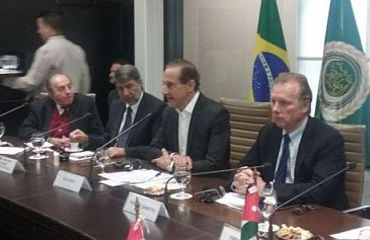
São Paulo – Mutual investment, boosting trade, and the measures needed in order to strengthen Brazil’s ties with Middle East and North Africa countries were the topics of a meeting between the Council of Arab Ambassadors in Brazil and the president of the Federation of Industries of the State of São Paulo (Fiesp), Paulo Skaf, this Tuesday (4).
“We will undertake all necessary efforts to increase trade and investment [between Brazil and Arab countries],” Skaf told the group of diplomats.
The delegation comprises ambassadors and chargés d’affaires from Palestine, Saudi Arabia, Kuwait, Jordan, Libya, Egypt, Sudan, Mauritania, Tunisia, Morocco and Algeria, plus the League of Arab States ambassador to Brazil, Nacer Alem.
The group’s visit was arranged by the Arab Brazilian Chamber of Commerce, and its delegates Osmar Chohfi, the vice president for International Relations, and Michel Alaby, CEO, were in attendance.
Skaf stressed São Paulo’s relevance and representativeness within the Brazilian economy, highlighting the state’s leadership role in several industries. He also touched on the work of Fiesp in fields including education, culture, and sports.
Ibrahim Alzeben, the ambassador of Palestine and dean of the Council of Arab Ambassadors, said Fiesp is “highly prominent within the national framework” and noted the part played by Arabs in the makeup of Brazilian society. “This city and this state bear witness to the participation of Arabs in building this country.”
The ambassador called upon the partnership of Fiesp to break down the barriers that still prevent trade between Brazilians and Arabs from increasing. “We would very much like to work together to eliminate the obstacles that hamper the development of relations between Brazil and the Arab countries. There isn’t a clearly defined law on investment, or an agreement to prevent double taxation,” Alzeben said.
The diplomat championed increasing the variety of products traded between the two countries. “Our portfolio cannot be restricted to meats and oil,” he said, mentioned two of the most bought and sold items between Brazil and Arab nations.
To the president of Fiesp, after the change of government at the federal level, Brazil is regaining the trust of financial markets and should be targeted by foreign investment again, therefore solving the double taxation issue is of great interest to the country. “We must find a way to prevent duplicate taxation and facilitate mutual investments,” he asserted.
“Kuwaiti investment in Brazil needs to be protected through legal support,” said Ayadah Alsaidi, the ambassador of Kuwait to Brasília. He added that his country invested USD 1.2 billion in Brazil in the past few years, and took a hit from the Brazilian financial crisis.
Ahmed Elsiddig, the ambassador of Sudan, remarked that Africa is flooded with Chinese goods and said he would like to see more Brazilian products in the continent, since he rates them as having higher quality than those from the Asian country.
Alaa Eldin Roushdy, the ambassador of Egypt, stated that his country has also weathered a political crisis, but said that now it boasts the stability needed in order to pull in foreign capital. “There are opportunities for Brazilian companies to invest in Egypt,” he said, adding that investment must be a “two-way street,” i.e., if Brazil wants Arab capital, it must also encourage local capital to venture into the Arab world. “Brazil needs to encourage investment in Arab countries,” he claimed.
Osmar Chohfi recalled that the Arab League countries are Brazil’s fourth biggest trade partner and seconded the notion that variety is needed in trade. He also expounded on the Arab Chamber and Fiesp’s partnership in diplomatic relations with the Middle East and North Africa. “Fiesp and the Arab Chamber are relevant players in enhancing Brazil’s ties with the Arab countries,” he pointed out.
*Translated by Gabriel Pomerancblum

