



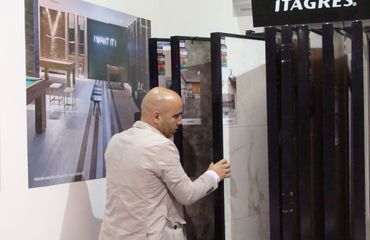
São Paulo – The Arab Brazilian Chamber of Commerce is taking eight companies to the Big 5, the Middle East’s premier building industry expo, set to run from Monday (21) to Thursday (24) in Dubai, the United Arab Emirates.
The companies are sinks and bowls maker Tramontina; brush maker Pincéis Atlas; waterproofing company Cipatex; porcellanite tile company Delta Porcelanato; tile manufacturers Embramaco and Itagres; and marble and granite companies Marbrasa and Imetame.
Delta Porcelanato will be exhibiting in the Big 5 for the first time. It has returned to exporting recently. “We went back to being an exporter a year and a half ago, and our products are well-suited to Arab countries. We are hoping to introduce our brand at the Big 5,” says Export manager Geraldo Costa.
He explains that the company makes floor tiles for homes and offices. At the Big 5, Delta will be showing its mid- and high-end product ranges. While it does not sell to any Arab countries, the company is betting on them to see foreign sales increase. “The Middle East is looking better than Europe and North America now. There isn’t as much competition,” Costa says.
It will also be Cipatex’s first time exhibiting at the Big 5. It offers PVC geomembranes, which are a multipurpose waterproofing material.
“Common uses include fresh water reservoirs, residential compounds and schools; fish tanks; and tunnels, to prevent leakage from rains; roofing; waterproofing for ore extraction; landfills; and the ground near oil tanks to avoid contamination in the event of a spill; It’s a hydrocarbon-resistant material,” explains Sales manager Aureovaldo Casari.
The company sells to Australia, Chile, Bolivia and Argentina. The Middle East came on the Cipatex radar after a decision to increase foreign sales. Casari believes his product can do well in the Arab countries, since it’s unlike any of the waterproofing available in the region.
“In Arab countries they use a lot of polyethylene, which is a harder product. PVC is more flexible and easier to install. It also costs less to install and is easier to repair. Its retention rate is much higher,” the manager points out. The goal at the expo is to find a distributor.
Pincéis Atlas has been to two past Big 5 editions and is returning after a five-year hiatus. “We made changes to our lines and we realized that with a few modifications and adaptations, we’ve become more competitive when it comes to that region,” says César Vinicius Costa, the Export manager. According to him, the brand now makes brushes with packaging in Arabic, which should be a plus in competing in the Middle East.
It currently ships product often to buyers in Lebanon and Kuwait, in addition to the occasional sale to Saudi Arabia and Egypt. “The idea is to find new distributors in new countries or ones we don’t sell to that often,” he explains.
More space
To help the companies maximize their business opportunities at the Big 5, the Arab Chamber has increased its area. “Our stand is much bigger than last year, and that enables people to have private offices to hold meetings in,” says Arab Chamber CEO Michel Alaby.
According to him, the Middle East construction industry remains a powerhouse. “In the UAE, you have the upcoming Expo 2020, the 2022 FIFA World Cup in Qatar, and Saudi Arabia has its Vision 2030 plan whereby they are looking to build different cities to decentralize its population away from Riyadh,” Alaby points out.
He advises businesses to keep tabs on international construction industry trends. “I think they should check out a few other countries’ stands to see the competition, the new technologies and the innovation that’s going on in the industry,” he concludes.
*Translated by Gabriel Pomerancblum

