



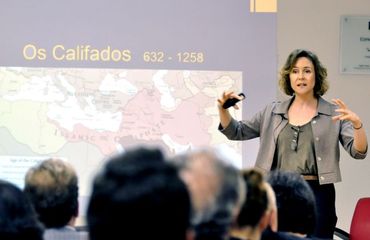
São Paulo – The political instability many Arab countries are experiencing nowadays originated in the 20th century as a result of the foreign rule in Middle East and North Africa countries, according to the historian Arlene Clemesha. In a lecture delivered Tuesday evening (16th) at the Arab Brazilian Chamber of Commerce to an audience of roughly 80 people, including the Chamber’s president Marcelo Sallum, Clemesha listed some of the reasons that led to the popular uprising known as Arab Spring, to the conflicts in Palestine, the continuous skirmishes among countries in the region, and the emergence of extremist groups.
Clemesha asserted that many of the current problems originated during World War I (1914-1918), as Great Britain, France and then-czar-ruled Russia discussed their influence on the Arab world. “The Middle East was one of the settings of World War I and several European powers were interested in the Ottoman Empire: France, England and czar-ruled Russia. They were aware of the region’s assets, such as Iran’s oil, for instance,” she said.
Clemesha explained the consequences of the signing of the secret Sykes-Picot agreement, in 1916, drafted by diplomats from France and the United Kingdom to define where each country would exert its influence. Britain would control southern Iraq and Kuwait, and gain influence over Jordan. France would occupy the northern region, where Syria, Lebanon and Northern Iraq are. Palestine was not assigned to anyone, but part of its population was supported by France, others by Russia and others, such as the Jewish, by Britain. This agreement, however, was only made known after the Bolshevik Revolution, in Russia, 1917.
Since the end of World War I, the Middle East and North Africa, already scarred by struggles since the VII century, became the target of constant disputes among the European powers. Foreign presence caused Arab nationalism and Islamism to spread as a political, religious and cultural movement. In Egypt, Gamal Abdel Nasser’s rise to power resulted in the nationalization of the Suez Canal, the main waterway connecting Europe, Africa and Asia.
The discovery of oil reserves in the region, mostly by the British, led to declarations of independence by Arab and Muslim countries dominated by the Europeans. In Iran, which is not an Arab country, oil was discovered in 1908. Reserves were also found in Kurdistan, Iraq, 1927, in Bahrain, 1932, and in Kuwait and Eastern Saudi Arabia, 1938. Syria, Lebanon and Jordan became independent in 1946 and Egypt, in 1952. Twenty years earlier, with Britain’s support, Saudi Arabia was declared a kingdom.
Clemesha remarked that constant Western presence in the region, and the European belief that Arabs were not ready to rule on their own, have influenced the formation of territories such as Palestine. The first draft of the United Nations’ partition plan for Palestine, in the 1940s, allocated a larger area to Palestinians than the area they currently occupy, and set forth that Jerusalem would be a “corpus separatum,” meaning it would not belong to neither Arab nor Jewish territories. The plan was not accepted.
Arab nationalism
Constant interferences in the region, invasion of territories, wars and secret political agreements, the historian said, led to the emergence and rise of Arab nationalism and of extremist groups.
Clemesha explained the differences between some of these groups to the audience. The Hezbollah, which emerged in Lebanon, the Muslim Brotherhood, from Egypt, and the Hamas, from Gaza, have political representation and usually negotiate with their adversaries. But there are examples of radical factions such as Al Qaeda, born of the Soviet invasion of Afghanistan in 1979; Boko Haram, which operates in Africa; and the Islamic State of Iraq and Syria (Isis).
“Many instances of political Islamism were spawned by the foreign rule in the region. Isis, for instance, is the outcome of United States presence in Iraq since 2003, a historically constituted phenomenon,” she said.
Lecture cycle
The lecture “Middle East, from the 20th to the 21st century: 100 years since Sykes-Picot” is a sequence to the first lecture delivered by Clemesha. In October 2013, the historian and professor at the Eastern Languages Department of the School of Philosophy, Literature and Human Sciences of the University São Paulo (FFLCH-USP) lectured on the formation of Arab peoples to an audience, also at the Arab Chamber headquarters.
“It was productive to show more of the Arab history. The audience was interested in the subject, heard me for nearly two hours and asked relevant questions,” she said. Clemesha’s presentation is part of a lecture cycle sponsored by the Arab Chamber. The next lecture is scheduled for October 14th.
In it, the professor and coordinator of Getúlio Vargas Foundation’s postgraduate course in Economics, Culture and Cities, Ana Carla Fonseca Reis, will discuss creative cities, how public space develops in them, the creative economy that flourishes in these urban centres and the governance and management of such municipalities.
*Translated by Rodrigo Mendonça
