



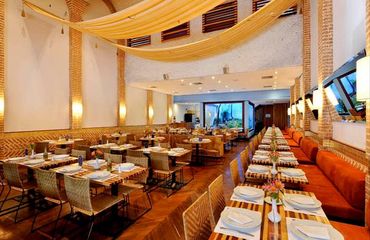
São Paulo – Arábia, one of the most famous Arab food restaurants in Brazil, plans to export snacks, including the traditional sfiha, to Arab countries. The restaurant, once only a small delicatessen in the city of São Paulo, currently has a well-established entrepreneurial structure, with micro-franchises, sales to supermarkets and an output of 20,000 snack foods per day. Now it is seeking international markets.
Arábia’s owner Sergio Kuczynski notes that in the Arab world, consumers hardly have the chance to go to the supermarket and buy a tray of sfihas, like they do in Brazil. He believes there lies a great market niche[GKP1] . “[GKP2] Sfihas are not as widely consumed in the Arab countries ,” he says. Kuczynski is married to Lebanese descendant Leila Youssef, his partner in Arábia and in charge of the restaurant’s gastronomy.
But how does one make a sfiha with Arab quality and standards? Nowadays, the product is [GKP1] handmade. “It is like jewellery,” says the general supervisor of the company, Lalo Zanini, about the[GKP2] zeal with which the products are made. And that is precisely why Arábia is developing its own snack machine. The idea is to gain productivity without letting go of the product’s essence. The machine should be ready for use later this year.
Kuczynski believes that they can potentially sell, in the Brazilian Southeast alone, 60,000 sfihas per day, three times what Arábia currently produces. The idea of exporting came about five years ago, when the restaurant was approached by potential importers from England. Back then, the owner explained to them that Arábia [GKP1] could not meet the increase in demand, but started to develop the idea of mechanically increasing the production.
The plan is to export not only the snack foods, but also other products such as the individual frozen dishes are already sold at the Arábia Express units in Garulhos airport, and are being introduced in the supermarkets supplied by the brand. “This is a growing market in need,” says Kuczynski [GKP2] regarding the individual dishes. Five kinds of dishes are currently available and others are being developed.
Arábia in the Arab World?
And Arábia’s plans for the Arab world, home to the kind of food that made the restaurant so famous, do not end there. The restaurant’s global expansion strategy includes opening units abroad, and that includes the Arab world. The countries are yet to be defined, but the company is open to discuss partnerships, according to Zanini. The general supervisor says he has already been to 65 countries and claims that no Arab restaurant he has visited around the world is as good as Arábia. That is why he believes the brand should be successful abroad.
Bazaar
The company also wants to import more from the Arab countries. Arábia plans to open a bazar where Arab products may be sold to the end customer[GKP1] . No place or date has been set yet, but the goal is to offer Arábia brand’s ready-to-eat products, such as snack foods, raw ingredients such as dried fruit, pistachio nuts, and even items such as decorative pieces.
“We already have this entire distribution network,” says Kuczynski regarding the retail brands the company already sells to. The new strategy includes plans to expand the product line. The products should be sold to these[GKP2] retail chains, but also via e-commerce and at Arábia’s own restaurants, besides the bazaar.
Just like with snack foods, there is a concern with the standard, with selling only unique, high-quality products. “We do not want to sell just another dried fig, we want to sell a wonderful dried fig,” says the owner. Arábia is already in talks with a potential supplier from Dubai, in the Emirates, but continues to seek partnerships.
Halal at the airport
Another plan the company wants to put in action is to sell[GKP1] halal meat at its restaurants, mainly at the two Express-format ones at the new international airport terminal, Terminal 3 of the Guarulhos airport, which get heavy rotation of foreigners. Many people ask about halal meat there, according to the owner.
Arábia is looking for a halal meat supplier in Brazil to partner up with. Halal products are made according to the Islamic tradition. As regards the meat, the animal slaughter follows a set of rules. Airlines that fly to the Middle East, such as Qatar Airways, Emirates, Etihad Airways and Turkish Airlines, operate from Terminal 3, where Arábia’s units are located. Currently, Arábia only uses halal meat in its dishes eventually, when Muslim delegations go to the restaurant. But in such cases, the clients bring the meat for the restaurant to prepare.
Arábia restaurant has recently become a member of the Arab Brazilian Chamber of Commerce and will have the organization’s support in pressing ahead with its plans pertaining to the Arab world. As a matter of fact, Zanini has been in the company for five months in order to bring about partnerships and implement new strategies. All of that, however, keeping Arábia’s tradition, according to him.
It started small
Arábia was founded in 1987 by Kuczynski and Leila Youssef as a four-table delicatessen. Leila, who lived in Lebanon with her family as a child, cooked the Arab dishes that soon became a hit. In 1992 the couple opened their 120-seat restaurant on the Haddock Lobo Street. Soon, the place became a reference in Arab cuisine and is currently ranked as one of the best restaurants in São Paulo.
Today the company processes 10 tonnes of meat per month. Besides the main restaurant on Haddock Lobo, the brand also owns an industrial kitchen and an office in the district of Vila Olímpia, and five Express restaurants – two at the Guarulhos airport, one in Vila Olímpia, one in JK mall and one in Iguatemi mall. They also work with takeaway orders and catering for events. At the Express restaurants, the food base is basically the same as in the main restaurant, but there are fewer options in the menu.
Arábia Restaurant
Website: www.arabia.com.br (in Portuguese)
Phone: (+5511) 3061-2203
