



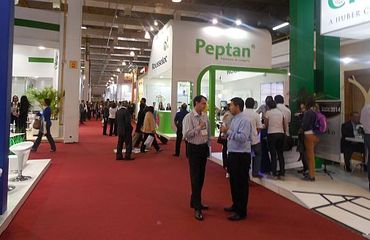
São Paulo – Executives from eight Arab companies who are attending the pharma industry fair CPhI South America have engaged in matchmaking with Brazilian exporters this Tuesday (5th) and claimed they may place orders in the long run. They expressed surprise with the technology of Brazil’s pharma industry. The importers have come to the fair and the matchmaking at the invitation of the Brazilian Pharma Chemical and Pharmaceutical Inputs Industry Association (Abiquifi), with backing from the Arab Brazilian Chamber of Commerce.
The Business Development manager for Saudi Arabia’s Tabuk Pharmaceuticals, Amr Al Jallad, said he was “pleasantly surprised” by the technology and the variety of Brazilian medical products. “The companies boast vast experience and make sophisticated products. They have exceeded my expectations, because Brazilian companies do not market themselves much overseas,” he said. The leading suppliers of medication to Saudi Arabia, he said, are South Korea, the United States and European countries.
The executive manager for Sudan’s Bajafar Medical, Mohamed Yousif, said he had not imagined Brazilian enterprises had such “strong potential,” and claimed his company is very likely to do business in the country. “The major Brazilian companies can make a grand entry into the Arab world. I even find it odd that they are not there already,” he remarked.
He said he came to the matchmaking looking for medication for various diseases, among them diabetes. Yousif is also interested in over-the-counter drugs such as flu medication and creams.
The marketing manager for Syria’s Unipharma, Rufaida Ghanoun, is looking to import Brazilian medicine and resell in Syria and other Arab countries. “We can sell in Syria and Iraq and then ship the product to other markets, such as Libya and Iran,” she said. The CEO of Egypt’s Biopharm, Kandil Osama said he was not familiar with Brazil “besides football.” In his first visit to the country, the executive is seeking natural medications, herbs and cosmetics. “We are going to turn our attention to Brazil, we were not aware of how advanced Brazilian manufacturers in this industry are.”
Long run
The International Projects manager for Abiquifi, Natália Porto, said this was the first time they brought companies from the Middle East and North Africa to partake in matchmaking as part of the Brazilian Pharma Solutions project, sponsored by the association and by the Brazilian Export and Investment Promotion Agency (Apex-Brasil). In the past, the project has focused on companies from South America, Mexico and Russia.
“The presence of Arab executives was called upon by the companies affiliated with Abiqifi. They expressed intentions of dealing with importers from Egypt and Saudi Arabia. We decided to broaden the scope and include other Arab countries as well,” she said.
In 2013, Arab countries imported a combined US$ 18.59 billion worth of pharma products. Of those, US$ 11.57 million concerned products purchased from Brazil. According to the Abiquifi manager, there is room available for Brazilian companies to increase their sales to Arabs. She noted, however, that deals in this industry must be made with an eye to the medium- and long-run, since cosmetics and medication hinges on approval from regulatory bodies before they can enter a country.
“When it comes to medication, there is this barrier, but in case the product is interesting, it will gain access to any market. It takes two to three years for the doors to be opened. It is worthwhile, because these companies are large and well-known in their region, and by selling to them we can find our way to other clients,” she said.
The Arab Chamber business executive and support coordinator for Abiquifi’s project,t Nádia Abdallah said 20 Arab companies have registered with the Arab Chamber looking to participate in the matchmaking. Of those, ten were approved and eight travelled to Brazil. “This is one of the major actions designed to bring pharma companies to Brazil. The Arab Chamber has joined the project in order to facilitate the meetings,” she said.
The business development manager for Laboratório EMS, Flávio Pereira de Magalhães, said the meetings with Arab companies have been productive, and that his company’s market share can increase. EMS already exports medication to Oman, Kuwait, Lebanon, Jordan, Syria and the United Arab Emirates. He said one of the challenges when it comes to selling medication, namely the long time it takes to obtain approval from regulatory agencies, can even constitute an opportunity. “Since demand is strong in some countries, a few of our competitors give up waiting. There are opportunities to be taken,” he said.
Service
CPhI South America
Expo Center Norte
José Bernardo Pinto St., 333, Vila Guilherme, São Paulo, SP
August 5th and 6th
Information: http://www.cphi-sa.com.br/pt/ (in Portuguese)
*Translated by Gabriel Pomerancblum
