


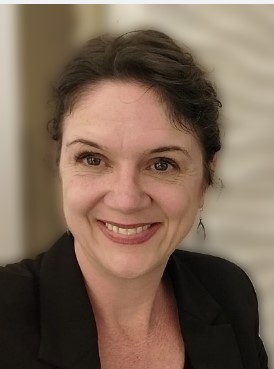
São Paulo – Her grandparents were Arab and when she was a child she watched her father João Paulo Basile, a Spaniard of Lebanese origin, practicing his favourite hobby: cooking. Graduated in architecture, Simone Mattar is currently one of the authorities in Brazil in gastronomy and art (food design) and from the 9th of August on, she will present part of her work in an exhibition called “Como Penso Como” (a pun, meaning something like “I think how I eat”), at Sesc Pompeia, in the city of São Paulo. The exhibition shows the different faces of Brazilian identity through cuisine.
“Relations between family and food have marked me since childhood,” said Simone, regarding the influence of an Arab family custom, that of coming together at meal times, on her career choice. Her father learnt to cook with his mother-in-law, also of Lebanese origin. “He cooked Arab food at home; my father was a gourmet,” said Basile. Her father, who has already passed away, worked in the financial market and had farms.
Simone says that her farther often took four months preparing a meal. As he had farms, that was where he got the pork, lamb or beef. And as he travelled much, he got inputs in several parts of the world, including wood for smoking, in Northern Europe. “I remember that he once opened a bag that was packed with salmon,” she recalls. The family farm was in the interior of the state, but even their house, in São Paulo, had half of its land covered by a vegetable garden. The family trips also took gastronomic routes.
Motivated by the passion of her father and by the appreciation she had for cuisine and for drawing, from an early age, Simone started studying Graphic Arts and Industrial Design at Armando Álvares Penteado Foundation (FAAP), then Architecture at Mackenzie and she finally got specialisation in Gastronomy. She operates as a "food design" consultant for Brazilian and foreign universities, apart from having worked in "food branding", developing projects for restaurants and food sector companies for 20 years. In recent years she has dedicated herself mostly to research and projects in the area.
The exhibition
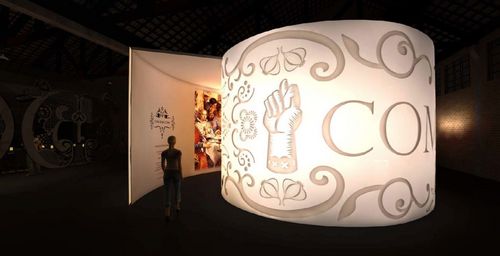
At the exhibition at Sesc Pompeia, Simone shows how man has related to food throughout history, from totem rituals to fast food and current international gastronomy. She is trying to bring “eating” closer to “thinking”, recalling, for example, that just 4% of food diversity in the world is consumed. In her work, the artist relates global movement to the way people eat. “In my opinion, the great questions of culinary art involve theoretical thinking applied to humanity in a broader sense,” she said, in promotional material.
The exhibition will be in several parts, among them a sensorial "Lightlock", a kind of room in which visitors will have their senses awakened by visual, olfactory and auditory stimuli related to Brazilian culture, like the smell of coffee, cake and the clinking of cutlery. In another room there will be a 25metre roll cake in fabric, produced by 35 women in NGOs. At the other end of the area, in contrast, there will be two films using state-of-the-art technology telling the story of "food design" based on the artist’s vision.
There will also be animations about how Simone sees art in cuisine and also a space dedicated to sampling. In this area, there will be two daily sessions, each for 30 people, for 1:30 hour. Visitors will be entertained by actors who declaim texts and enact characters related to dishes. The menu is inspired on moments and personalities of Brazilian history. It will, for example, include a lighting fixture made out of cassava filigree, and a porcelain sculpture out of which a banana made out of cinnamon mousse and banana sweet sticks out, in reference to the Brazil of Carmen Miranda.
The Granddaughter
Simone said she has a great desire to come closer and work with the Arab community in Brazil, despite not yet having had an opportunity for that. As she promotes workshops, gives talks and consultancy in "food design" to foreign universities, she says she would greatly like to do that in an Arab institution. She says that her drawings bring to mind Arab drawings, with traces of Portuguese baroque.
Her grandfather on her mother’s side was born in Lebanon and her grandmother was also of Lebanese origin, despite having been born in Brazil. Her father’s family is Spanish, but also of Lebanese descent, and, before having come to Brazil, lived in Cadiz, a city with great Arab influence and inhabited mostly by people from the Arab world. Among the Arab food, among Simone’s favourite is Chich Barak, a dish that is similar to cappeletti with curds.
From August 9 to September 8
Sesc Pompeia – Rua Clelia, 93 – Pompeia – Sao Paulo, SP, Brazil
Admittance is free
*Translated by Mark Ament
