



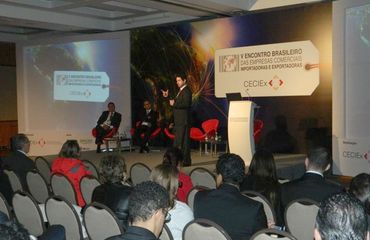
São Paulo – This Tuesday (27th), at the 5th Meeting of Trading Companies, businessmen and international market specialists, criticized Brazilian foreign policy and the under-exploration of free trade agreements by the country. The meeting took place at the Renaissance Hotel, in São Paulo, and was attended by trading companies, government officials, and foreign trade industry leaders. The vice president of the Brazilian Foreign Trade Association (AEB, in the Portuguese acronym), Mauro Laviola, said Brazil lacks participation in more evolved markets, and said the country currently sustains only five agreements, with “restricted” markets, three of which are not in effect.
Due to its participation in Mercosur, a bloc also comprising Argentina, Uruguay, Paraguay and Venezuela, cannot enter into tariff preference or free trade agreements by itself, only with the group. And the Mercosur has few agreements, at present solely with India, Israel, Palestine, Egypt and the Southern Africa Customs Union (SACU). According to Laviola, only the deals with India and Israel are already effective. At the same time, he said, the Mercosur is experiencing a difficult moment, and has not yet evolved into free trade. The bloc is proving to be more of a political than a commercial instrument, according to Laviola.
The coordinator of International Economic Relations Studies at the Board for Economic Relations of the Applied Economic Research Institute (Ipea), Ivan Tiago Machado Oliveira, said right now, the worldwide question is where trade regulations will be created. “The WTO is in a standstill when it comes to setting regulations,” said Oliveira regarding the World Trade Organization. He mentioned that the Doha Round, a trade agreement between developed and developing countries which opened in 2000, has failed to reach a consensus thus far.
“Where will the rules be set forth: under the multilateral system, which is stuck, but has a history in conflict-solving, or under preference agreements?” said the Ipea executive. He noted that Brazil is treading three paths when it comes to international trade: the preference for multilateralism, the integration of South America, and the trade agreements with India and Israel. “Foreign policy does not contemplate the generation of trade,” he said. The Mercosur began talks for an agreement with the European Union, but no conclusion was reached either. “I am sceptical as to whether an agreement will be reached with the EU,” said Oliveira.
The coordinator said Brazil’s private sector is not as pro-opening as it claims to be. “We are marginalizing our trade negotiation agenda,” said Oliveira. He said, however, that this might be a good time for Brazil to turn to international trade, seeing as the economic growth model based on credit, consumption and commodities’ exports is “coming to an end.” “Perhaps the scenario of relative crisis is positive in that we will rethink our international trade,” he said.
The meeting’s opening address, which discussed international agreements, also featured Adoni Hernandez Bengoa, a lawyer from Cuatrecasas, Gonçalo Pereira, and the internationalization manager of the Brazilian Export and Investment Promotion Agency (Apex), Juarez Leal. Leal showed the trading companies’ executives Apex’s work in appointing strategic markets for the internationalization of businesses. The agency conducts a survey in order to recommend the best strategy for each business to place its products. There are markets for which the Apex advises on monitoring, i.e. those in which Brazil already has a significant presence, such as Argentina, Venezuela and France. Then, there are the markets in consolidation, i.e. those that Brazilian enterprises are already familiar with, but which hold promise for growth in coming years. These include United States, Peru, Colombia and Chile, among others.
Regarding developing markets, the Apex refers countries like Russia, China, Saudi Arabia and Africa, of which some knowledge is available, and in which long-term growth is possible. Markets for prospecting are little-known countries that nonetheless have potential for trade; countries that fit this profile include Egypt, Turkey, India, Mozambique and Nigeria, among others. There are also unknown markets which are however good buyers, like Iran and Romania.
The meeting was held by the Brazilian Council of Importing and Exporting Companies (Ceciex), with backing from other organizations such as Apex and the São Paulo Trade Association (ACSP). The two organizations are working in tandem with the Ceciex to promote products by micro, small and medium businesses internationally, by means of the trading companies. According to the Ceciex chairman Roberto Ticoulat, right now there are approximately 30,000 importing and exporting companies in Brazil.
*Translated by Gabriel Pomerancblum
