



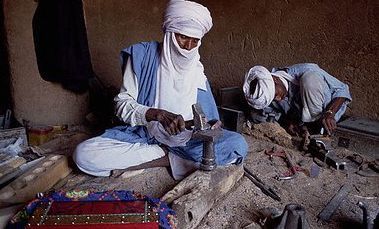
São Paulo – Next week, Brazil starts a week of training to grant the Algerians in Tamanrasset region knowledge for the development of jewels. Algeria has a great wealth of precious gems, mainly in the Sahara Desert, but they are not explored. “We are going to collaborate for the world to know the gems of the Sahara Desert,” said the president of the Brazilian Association of Small and Medium Producers of Gems, Jewels and Similar Stones and Mining (Abragem), Harilton Carlos de Vasconcelos Sobrinho.
The Arab country works with goldsmithery in a millenary ritual, melting silver on fire boosted by bellows, for later modelling on an anvil, a manual instrument. “They do not use gems as they don’t cut them,” said Vasconcelos, coordinator of the project for Algeria. The objective, according to the president at Abragem, is that they learn to cut stones of the Sahara and use them both in jewels made according to their millenary tradition and in those to be produced with more modern techniques to be taught by the Brazilians.
The project for cooperation, an initiative of the governments of both countries, is executed by Abragem and developed by the Brazilian Cooperation Agency (ABC). In Algeria, initially, it was in the hands of the Ministry of Mines, but is currently developed by the Ministry of Handicraft. In the Arab country, it is currently operated by the Chamber of Handicraft of Tamanrasset, a province in southern Algeria. In the final phase of the project, the Algerian interlocutor was the National Agency of Traditional Handicraft (Anart).
Vasconcelos should be in Algeria to start the training, to begin next Friday (15), and to be headed by one of Brazil’s main specialist in the areas of geology and minerology, Pérsio de Moraes Branco. The first part of the initial phase of the training will focus on gemology and will provide general notions on the matter. The lessons will take place up to the 30th of November. Still in the initial phase, but at a second moment, the Algerians will have training in artistic and mechanical cutting, for some ninety days.
The training will take place at the installations of the Regional Organisation for Geology and Mines (ORGN). Apart from this first phase, there will be another three, each lasting around ninety days. The second will be turned to goldsmithery, the third to mineral handicraft and the fourth to jewellery design. In total, there should be training of some 60 professionals from Algeria, who will later work as multipliers of this knowledge.
The government of Algeria is building a new school turned to the area and the idea is for the professionals trained by the Brazilians to be able to teach in future. The site covers 6,000 square meters on two levels, with 25 apartments to receive students from all parts of the country. The school will be run by the Algerians, according to Vasconcelos, and Abragem will be at their disposal in case of need. Interest, according to Vasconcelos, has already been shown in similar cooperation with another centre of excellence in the area, which is being created in Botna province.
Raw material and talent
Vasconcelos shows himself greatly enthused with the work in the African country. According to him, Algeria sought cooperation in the area for many years and found close ties with Brazil. “They will make use of these minerals that they have and the quality of their work. There are many artisans in the country, and they take much care with the area, to the extent that they have a Ministry of Handicraft,” said the president at Abragem. Brazil should take professionalization to the area, establishing a new productive sector, which may, in fact, export jewels and cut stones, according to Vasconcelos.
The starting kick for cooperation took place in 2007. From then on, there have already been several activities, among them the presentation of Brazilian jewellery and stones at the International Salon of Traditional Handicraft and Arts of Algeria, in 2010. A group of Algerians also came to Brazil to learn about production, museums and teaching institutions operating in the area, and Brazilians travelled to the Arab country to learn about the local reality and give a seminar on the sector. This time was also necessary for some formal measures, like the signing of agreements, tenders and the shipping of equipment to make the work viable, among others.
*Translated by Mark Ament
