


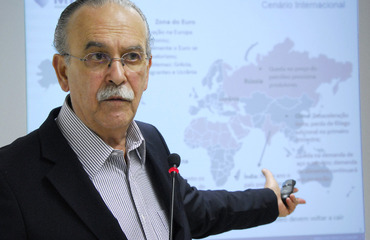
São Paulo – Economist José Roberto Mendonça de Barros, from consulting firm MB Associados, believes Brazil will not grow next year. In a lecture delivered on Tuesday (9th) in São Paulo, at the offices of the Arab Brazilian Chamber of Commerce, he expounded on the country’s economic scenario, which he described as very complicated, and outlined a few strategy suggestions for entrepreneurs to handle the crisis in the short term, and keep their businesses afloat going forward.
“In 2016 things will remain sluggish, though less so than this year, but GDP (Gross Domestic Product) will have zero growth,” said Mendonça de Barros, referring to MB Associados’ expectation of a flat economy next year. For 2015, the think tank forecasts that GDP will shrink 1.5%. “There is no way GDP will grow in 2016, for there is a dearth of growth sources,” said the economist, citing the lack of investment and the rising unemployment.
Barros discussed the global scenario, but ascribed Brazil’s economic issues primarily to domestic political and economic phenomena. He remarked that Brazil went from 7.6% growth in 2010 to 1.5% retraction in quarter one this year. “The decline was a very abrupt one,” he claims. According to him, the year began with hiking inflation, an eroding trade surplus and a weakened real (the Brazilian currency). The GDP decline, says Barros, bred “huge” pessimism about the economy.
To the economist, this situation stemmed from president Dilma Rousseff’s loss of power to National Congress and the fact that she campaigned in one direction and then moved in a different one once she took office. “The Executive branch lost control of the political process,” Barros told the audience.
He cited events such as shrinking demand coupled with news of mass dismissals in the auto industry, the realization that Petrobras was in a rough patch, the shutting down of construction sites by building firms associated with the oil company, workers’ perceptions of a stagnant labor market, and the fact that the banking system had a credit issue with Petrobras, which had the best credit rating in the country until then. From that point on, said Mendonça de Barros, banks became stricter towards lending.
The economist claims expectations improved once Petrobras released its financial statements, and now optimism tends to be sustained. However, he said, the economy will require further adjustments next year, since Finance minister Joaquim Levy will not have as much headway as he would like in implementing his current plan. “The fiscal adjustment will be limited in scope,” he said. Toward the end of the year, Mendonça de Barros believes the country will see some growth.
But Barros believes agriculture and mining should thrive despite the crisis, considering the good performance in the last crop and the positive outlook for the upcoming one. The sectors hit the worst by the economic downturn include industry and civil construction. According to Barros, while insolvency hasn’t increased among natural persons yet, it has for corporations, causing concern from the banking system.
The inflation rate, which climbed this year mostly as a consequence of administered prices, such as gasoline and energy’s, will likely go down in 2016, the economist said. Barros sees no reason for the Central Bank to keep raising interest rates, seeing as inflation is set to drop. “Government finances will improve a little,” he asserted.
According to Barros, Brazil is making a two-pronged transition, in political and economic models. The political structure that governed the country for 12 years is over with, says the economist. “PT [the Workers’ Party] is in for a landslide loss in next year’s elections,” he said. Regarding corruption claims, the economist said there is “more to come” and that there will be “no such thing as a former president [Lula] running again in 2018.” Mendonça de Barros believes the economic model whereby everything is run by state and growth is solely consumption-driven is a thing of the past. “That model has failed abysmally.”
Having said that, he gave suggestions for businesses to sail through the recession [which he said should last two years] without ruining their future. The first tip was to focus on exports and on going global. He also advised corporations to strive towards best practices, cost cutting and innovation, channel balance sheet strength into consolidation and purchase of good assets at good prices, and reduce dependence on fiscal favors and subsidized credit from all levels of government.
José Roberto Mendonça de Barros believes Brazil will get growing again come 2017 and that there will be lessons to learn from this period. “The situation is a tough one, but there are ways out,” he told the audience, stressing on several occasions that he is not a “pessimist.”
"Brazilian Economic Outlook" is part of the Arab Chamber’s lecture cycle, with featured speakers discussing economics, history, law and other topics to an audience of business executives. The Chamber’s former director Mário Rizkallah played host to Barros’ lecture, which was opened by president Marcelo Sallum. Other prominent figures attended, including Arab Chamber Foreign Trade vice president Rubens Hannun and the Omani ambassador in Brasília, Khalid Al Jaradi.
*Translated by Gabriel Pomerancblum
