



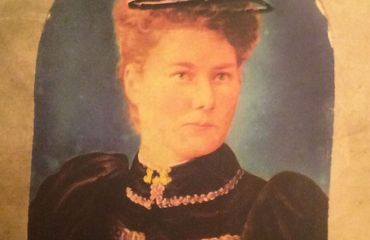
São Paulo – The Brazilian journalist and writer Wilma Ary launched a book in Lebanon this month about the story of her grandmother, Miriam Pease Bo Sauder, a British woman who married a Lebanese and lived in the Arab country for several years. The book is written in English and reproduces manuscripts Sauder wrote between 1906 and 1918, while living in the Middle Eastern country and tending to children affected by World War I at an orphanage.
Wilma collected copies of her grandmother’s writings with relatives and then got ahold of the originals. In contacting the former, since she hasn’t mastered English, she sent the material for translation. With the originals in hand, she decided to work the texts into a book, and added some of the story of her mother, Pearl, who moved to Brazil with her Lebanese husband Wadih Ary. He used to live in Ceará, Brazil, but returned to Lebanon seeking a bride, and that’s when he met Pearl.
Wilma, who had two other books published, released the piece on her grandmother in Portuguese in 2008 on the publisher of São Paulo university Universidade Paulista (Unip), whose communication department she currently works in. Besides Pearl’s life story, the Brazilian version features an introduction on World War I, which the English edition lacks. Wilma organized both editions.
The chance to publish in Lebanon came up after Wilma travelled to the Arab country in 2013 and met with the Lebanon-based Brazilian writer and researcher Roberto Khatlab, director of the Latin American Studies and Cultures Center (Cecal) at Université Saint-Esprit de Kaslik (Usek). He read the material and got it published through Beirut’s Dar Saer Mashrek. Khatlab himself wrote the English introduction for the book, and the anthropologist Khater Abi Habib, the preface. Both introductory texts explain the historic context of the age of the manuscripts. Rachel Saliba edited the English edition.
“She saved lots of children,” Wilma says of her grandmother, who met her husband, Leas Bo Sauder, in New Zealand. The two of them lived in the Pacific country and met through Miriam’s brother, who was Sauder’s partner at a bakery. Sauder and Miriam married, but he had an ulcer so they returned to Lebanon. Miriam started writing after living in several cities, until she finally moved to Broummana, where there was a community of British Quakers.
There, in Broummana, Miriam cared for children at an orphanage and played a key role in protecting them through the war. By then, she already had seven children of her own. Wilma’s grandmother died of Spanish flu, weakened by hunger, according to her granddaughter. Pearl, the journalist’s mother, was born back in New Zealand and was working as a nurse at a hospital when she met Wilma’s father, with whom she moved to Fortaleza, in Brazil’s Ceará state. They had seven children. The journalist who organized the book was the next-to-eldest and is now aged 77.
The English edition was launched at the Antelias Book Fair on March 14th this year. It is on sale from the publisher (see information below). The Portuguese edition can be found in São Paulo, at a bookstore called Expressão Popular, or directly from the organizer (information below).
English version:
In the Midst of Starvation – Diaries of Miriam Pease Bo Sauder in Lebanon
Publisher: Dar Saer Mashrek, Beirut, Lebanon
Online sales: www.entire-east.com or [email protected] (email)
Portuguese version
O Diário de Míriam Bo Sauder
Publisher: Universidade Paulista (Unip)
Sales: Expressão Popular bookstore (Rua Abolição, 266, São Paulo) or directly from the organizer, by email, at [email protected]
*Translated by Gabriel Pomerancblum
