


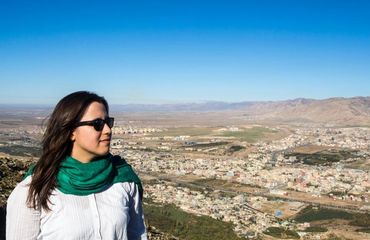
São Paulo – The reality of women, their struggles and challenges, has always engaged Brazilian journalist Talita Ribeiro, 28. But it was in November of this year that their cause took her to the center of the conflict in the Middle East and to the reality of war-plagued countries. Now, after visiting refugees in Jordan, Iraq and Turkey (a non-Arab country), Talita is writing the book “Turismo de empatia: refugiados no Oriente Médio” (Empathy tourism: refugees in the Middle East) about what she experienced, and even including tips on tours and local cuisine. To publish the book and collect funds for projects that support the refugees, she turned to crowdfunding on the internet.
The journalist visited Israel and Palestine in 2014. In 2015, she was able to take a closer look at the reality of Kurdish women, an ethnic group that lives in territories across Iraq, Turkey and Syria and one of the hardest hit by the conflict between the Islamic State and global and regional powers. The majority of Kurds live in Kurdistan, an autonomous region in Iraq close to the Turkish border.
“I decided to go when I saw a picture of a woman taking off her niqab (black cloth that cover the face and body of Muslim women) and she was wearing a beautiful colorful dress underneath. I was in awe because she was fleeing the Islamic State in Syria and seeking shelter in Kurdistan. I did research and saw that Kurdish women, contrary to what we might believe, take part in the army and the PKK (political party). Usually we have an image of passive, oppressed women in the Middle East,” says Talita.
After becoming aware of this reality from afar, Talita wanted to see up close how these women dealt with the war and oppression. First, she went to Amman, Jordan. She spent 15 days there and interacted with refugees living in small houses around the capital Amman. She also got to know historic cities, such as Petra. Later, she took off to Iraq. The reality now facing the journalist was harder and its impact wasn’t limited to women.
“When I woke up in the middle of the night, I wrote about what I had experienced and this helped. The way the refugees in Jordan are living is very precarious, but when I got to Iraq I saw that it was even harder. They live in tents in refugee camps. It’s very cold. They have snow this time of year. And they are living in tents,” she says.
“Another case that I got to know was of a 12-year-old girl that was bought along with her mom from the Islamic State. Her father and brother disappeared. When they were bought, the mother was given back to her family and she spent another four days in the hands of the Islamic State. At 12 years old,” she recalls.
Christians are persecuted by Islamic State members. “Christian households are marked with an “N” (a reference to Nazarene, which alludes to Jesus Christ). They have a few options: one is converting to Islam. They can also flee or die. It changes from moment to moment,” recalls the journalist, who’s a Protestant. Another persecuted group is the Yazidis, an ethnical-religious minority which Talita also visited.
While preparing the trip, Talita wanted to embark on a personal experience and particularly to witness the reality of women living in the conflict-ridden area. However, in Iraq she changed her mind. “It occurred to me to write the book, raise money with it and wire it to some of the refugee support initiatives,” she says. While she was in Iraq, her husband, the photographer Marco Gomes, joined her in the trip.
The crowdfunding project intends to raise BRL 30,000 by February 6. The money should also go to two projects: one of them is Família Aziz, a Brazilian family that assists refugees by distributing food and providing medical attention and professional training to women. The other one is Top Brazilian Sport Academy, in Iraq. It teaches soccer classes to refugee children and youths.
Talita plans on using the cash to help these efforts and to publish the book “Turismo de empatia: refugiados no Oriente Médio” (Empathy Tourism: refugees in the Middle East). Donations start at BRL 10. People donating the minimum amount will receive the book in e-book version. Donors contributing higher amounts can get a hard copy, as well as T-shirts, mugs and photos.
Besides the stories the journalist experienced, the publication will show a bit of the beauty and leisure options in the places she went to. Erbil, the capital of Kurdistan, “is a modern city that could be anywhere in the world,” says Talita. The city has an Old City area that bears the marks of history and war.
Talita believes that once the conflict is over, as well as when the Syrian reconstruction begins, a new reality will arise, especially for women. “The men are dying in war. I believe there will be a change in behavior towards women. They’ll have to go out in the labor market, they’ll have to take on a leadership role,” she says.
For more information on the project go to https://www.catarse.me/turismodeempatia (in Portuguese)
*Translated by Sérgio Kakitani & Gabriel Pomerancblum
