



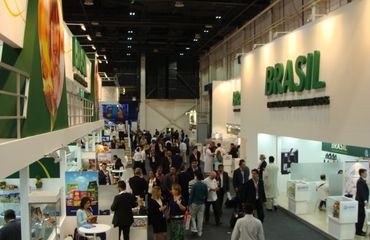
Dubai – At least two Brazilian enterprises have already closed deals at the Gulfood, a food industry fair which opened this Sunday (23rd) in Dubai, United Arab Emirates. Confectionery manufacturing companies Ricclan and Peccin have had orders placed by clients from countries in the region. Other companies featured at the Brazilian pavilion, organized by the Brazilian Export and Investment Promotion Agency (Apex-Brasil) and the Arab Brazilian Chamber of Commerce, were asked for quotes and delivery times.
The chocolate manufacturing company Peccin received orders from clients in Yemen, Kuwait and Palestine .Each will buy a 40-foot container worth of sweets. Peccin export manager Allan Wehbe said the fair started out very busy, but noted that the deals he closed on the first day are the result of a work initiated three months ago. “`Prior to the fair, I seek out my clients, send them product lists, price lists, I talk to them. I don’t leave everything for the last minute. When the time comes for the client to see me, we just set up the final details of the deals,” he said.
This was not the only reason for the orders. According to Wehbe, the company has also invested in boosting output. “This allows me to deliver more product in less time,” he said. The organization of the Brazilian stand has also helped. “It is large, well-lit, and attractive. Furthermore, Brazil is in the media spotlight right now, it is hosting the World Cup, and people are interested,” he said.
Confectionery company Riclan also had an order for a container from a Bahraini buyer. “It has been a good start. We have made good contacts with potential buyers who will probably place orders in the next few days. One is Omani,” said Riclan export department representative Luis Guilherme Fiorio.
The vice president of Pacific Group, which is representing company Coco do Vale at the fair, Rosivan Oliveira is betting on the event for the second time in order to sell coconut water in the Emirates. “We are offering a sweeter coconut water than last year.” The executive said the coconut water market is still under-tapped in the Emirates, and its sole competitor charges very high prices. “We can sell it cheaper,” he said. No additives are used in order to sweeten the coconut water. The product is extracted at a different stage of maturation of the fruit.
Expectations
This year’s Brazilian pavilion at the Gulfood features 77 companies, 32 more than in 2013, as per information supplied by the Apex. The area is larger than in other editions, and even includes a mezzanine where typical Brazilian foods are cooked, such as grilled meats, fruit juices, rice patties, among others.
This year, the Brazilian pavilion is larger than in past editions due to a prospecting effort carried out by the Apex and the Arab Brazilian Chamber. “We have raised awareness regarding the region’s importance, and showed that they are looking to expand into Brazil. And Brazilian businessmen are brave enough to make the investment, which is not cheap, in order to attend the fair,” said Apex business director Ricardo Santana.
According to him, the companies featured in the Apex’ 2013 Gulfood stand closed deals worth a combined US$ 150 million at the event, plus US$ 483 million in the months that followed. “Our goal is to surpass last year’s results,” said Santana.
The Arab Brazilian Chamber CEO Michel Alaby said the Brazilian participation is growing with each year. “Three years ago we had less than 20 companies. We are seeing growth due to the companies’ strategies, and to the fact that importers place value on Brazilian product,” he said.
The Gulfood was opened by the Emirati minister of Finance and Industry Hamdan Bin Rashid Al Maktoum. The fair features 4,500 companies and 80,000 visitors are expected up until next Thursday (27th).
*Translated by Gabriel Pomerancblum
