



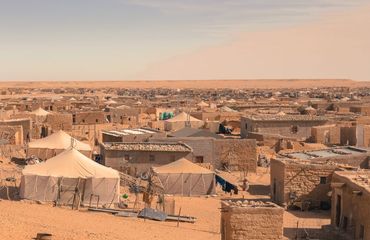
São Paulo – In May at the latest, two Brazilian filmmakers will complete a film on the struggle for independence in Western Sahara, a tract of desert in Africa that sits between Morocco, Algeria, Mauritania, and the Atlantic Ocean. Entitled “Um Fio de Esperança: Independência ou Guerra no Saara Ocidental” (A String of Hope: Independence or War in the Western Sahara), the documentary will be released in two formats: short and feature. The shorter version will premiere on May 2 at the Sesc Research and Training Center in São Paulo.
Script and directing duties are shared by Rodrigo Duque Estrada and Renatho Costa. Also sharing a background in International Relations, they travelled to Sahara in December 2016 to speak to the residents – the Sahrawis – and see how they live. The film will feature life stories and interviews with locals and their leaders. The refugee camp where some of them live in a state of exile is complete with its own president and parliament, as well as human rights and pro-women organizations.
“We’ve interviewed these people, from the president of the Republic and ministers of state to the nomads,” Estrada told ANBA. The filmmaking pair intends to spread information and awareness on the ongoing conflict in the Western Sahara. According to Estrada, the issue is neglected by media, politicians and international organizations around the world.
In making the movie, the director duo made interviews and shot footage in Madrid, Spain, in Antwerp, Belgium, in São Paulo, Brazil, and in three different locations in the Western Sahara: in the refugee camp; in Algeria’s liberated areas, where Sahrawis hold 15% of total area; and in the Moroccan-ruled occupied territories. “The occupied territories take up 85% of the Western Sahara. This is where the entirety of the area’s natural wealth resides, the phosphate, the coastal fishing,” says Estrada.
Western Sahara remained a Spanish colony for nearly a century. In the 1960s, the United Nations (UN) began working for decolonization. Spain had pledged to let go of the territory, but ultimately relinquished it to Morocco. A war broke out that lasted until 1991, when the UN achieved a ceasefire. “Decolonization is pending until this day,” says Estrada.
After speaking to lots of people, he claims Sahrawis are ever-more frustrated with the peace process. “After spending all these years in exile, living under the harshest of weather, the refugees dwell in the most barren portion of the desert, and several generations have been born into the refugee camps,” the filmmaker explains. Over 80 countries, however, have recognized the independence of Western Sahara. Brazil isn’t one of them.
The documentary is Estrada and Costa’s debut. Renatho Costa is an International Relations professor at Universidade Federal do Pampa, where he teaches Film and international Relations, as well as Film and Law. He holds a doctorate degree in Social History. Estrada has a diploma in International Relations and is currently pursuing a master’s in the same field. Although he did make a short film in the past, it was an amateur effort.
The idea to portray the Sahrawis came up in the second half of 2016. After five years studying the subject, Estrada thought he’d gone as far as books, science papers and academia could take him. “I felt the need to be in touch with the reality of refugees, to become acquainted of their history of resistance,” he says. Once he decided to go, he first considered doing interviews for books, research work, or articles, but during preparations for the trip he decided to make a film instead.
Estrada called up his fellow scholar and friend, who also devoted his time to studying the Western Sahara and the Middle East, to join him. He says being in touch with a nomadic culture and witnessing the resistance of a people who believe in their independence was a great experience. “Despite the grim political scenario, seeing children grow up in a place where there is nothing and nothing grows, and still have smiles on their faces, playing soccer, is a beautiful thing. It was a very enriching experience,” he asserts.
Once the feature film is completed, the filmmaking duo plans on entering festivals. Screenings of the short version will be followed by debates. They also hope to show the film in a film festival in the Western Sahara. ‘Um Fio de Esperança’ is a completely independent production with all costs met by Estrada and Costa. They are doing a crowdfunding campaign (see link below) to help pay for image and sound treatment, as well as trips for future festivals.
Documentary film: ‘Um Fio de Esperança: Independência ou Guerra no Saara Ocidental”
Short version premiere
May 2, 2017, 7:30pm
Lecture and screening
Sesc-SP Research and Training Center
Rua Dr. Plínio Barreto, 285 – 4th floor – São Paulo – SP
Registration: http://centrodepesquisaeformacao.sescsp.org.br/atividade/cultura-e-identidade-no-mundo-arabe
More on the film
https://www.projetonomos.com/umfiodeesperanca
Crowdfunding
https://www.catarse.me/umfiodeesperanca
*Translated by Gabriel Pomerancblum
