



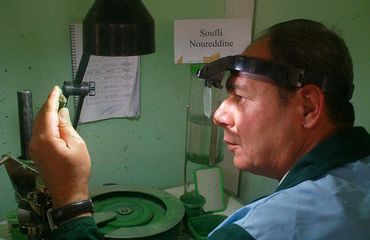
São Paulo – Two Brazilian experts travelled to Algeria to present classes of jewelry design to future professional of the sector at the city of Tamanrasset, 1,920 km south of the capital Algiers. The classes are part of the project Knowledge Transfer for the Production of Lapidated Gems, Jewelry and Mineral Handicrafts, organized in partnership by the Brazilian Cooperation Agency (ABC), linked to the Brazilian Ministry of Foreign Affairs (Itamaraty), and by the Small and Medium-sized Producers of Gems, Jewelry, Merchants and Prospectors Brazilian Association (Abragem).
Discussion on the project begun in 2007. Since then, a partnership focused on training started to be discusses and implemented. Seminars were held, trips for prospecting were taken a school for goldsmithery and cutting was opened. The first classes were taught in the first semester of 2015. The course will go on until 2017.
According to Abragem’s president, Harilton Carlos de Vasconcelos Sobrinho, the idea of exploring the Sahara desert’s stones came when the Algerians found out that those minerals could be cut into jewelry. Since then, the local government begun to look for countries and organizations interested in cooperating with the development of this new sector, as a way to diversify the Algerian economy, still too dependent on the exploration of its oil and gas reserves.
“Algeria has gorgeous stones, we were delighted when we heard. A lot of people think that the Sahara desert is only sand, but it’s just not true. It’s very rich in stones”, says Vasconcelos. Abragem’s president said that one of the reasons that drove the Algerians to seek for Brazilian support was the fact that in the country there are professionals that work with “opaque” stones that are very much like those found in Algerian territory. The quartzite, serpentinite, marble and granite are some of the stones that stand out in Algeria. There are, also, emeralds, topaz and crystals.
Another reason for the partnership is because Brazil has the largest variety of stones in the world and exports around a third of all gemstones. The country is a reference in the production of gems and jewelry.
The project with the Tamanrasset’s producers is sponsored by ABC. And it’s carried out by a partnership between Abragem and the Tamanrasset Chamber of Handicrafts and Arts, with the support of the Brazilian embassy in Algiers, and the ministries of Industry and Mines and Tourism and Handicraft.
The first course, of gemology (study of gems) and cutting was held between March and May of last year. The second phase, with classes on goldsmithery and casting, were given between September and December. The third phase, which started this month and will last until May, will present classes on jewelry design.
In the fourth phase, between September and December of this year, students will present mineral handicraft. The last stage, in March 2017, will focus on cooperativism, with the students transferring their knowledge to other students. Each phase has a new group of, on average, 20 students.
“Our goal is to show to the world, in approximately two years, at the end of the course, the Sahara jewelry. Then, we will take part in fairs and events”, says Vasconcelos. Algeria will not be the only country to receive the training. According to Vasconcelos, other countries already showed interest in obtaining the training, among them, Senegal.
*Translated by Sérgio Kakitani
