


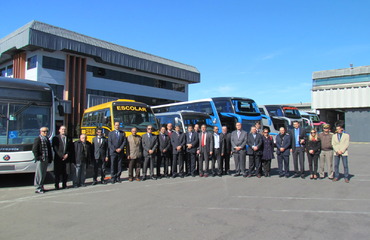
Caxias do Sul – The Rio Grande do Sul state-based bus manufacturing company Marcopolo will start exporting from Egypt before the end of the year. From September onwards, the company expects to deliver 260 buses to Kenya, seven to Dubai, 200 to Saudi Arabia, 15 to Jordan and 30 to Abu Dhabi – all made at the company’s plant in Egypt, which is a joint venture with company GB Auto. The information was supplied by the company’s Marketing and Institutional director Ruben Bisi to the group of Arab ambassadors who visisted the Marcopolo headquarters in Caxias do Sul, Rio Grande do Sul, this Friday (17th).
Marcopolo’s unit in Suez, Egypt opened in 2009 and has since produced 2,175 buses. According to Bisi, the company retains a 15.2% share of Egypt’s bus market. The unit has capacity for 2,000 vehicles per year, but there are expansion plans to increase it to up to 8,000, according to the executive. The company has 18 plants, in Brazil, Argentina, Colombia, Mexico, United States, Canada, South Africa, Russia, India, China and Australia, aside from Egypt. According to Bisi, Egypt has one of the lowest production costs, mainly due to low energy prices.
The Marcopolo executive said that presently, the company’s exports to the Middle East and North Africa originate from Brazil, but the goal is to supply the entire region exclusively with the Egyptian output. The plant will only have all of the products required in order to export by September. According to Bisi, the plant has now reached its breakeven point. Since the Arab Spring began, the company faced production issues, but decided to keep the plant and the employees until the market was back to normal, which is starting to take place now.
The annual demand of Arab countries for Marcopolo buses is around 8,000 units. “We are preparing the plant in order to increase its capacity,” Bisi said in an interview to ANBA. In Egypt, Marcopolo makes luxury buses, mainly to cater to tourist demand for the vehicles in the region. However, in the Arab country the company makes other buses for local consumption, such as microbuses, used in urban transportation.
In Egypt’s tourism bus market, Marcopolo competes with European companies that operate in the country. The executive told the Arab ambassadors about Marcopolo’s strategy of keeping small plants in different countries, but did not commit himself to opening additional units in other Arab countries. According to Bisi, in foreign countries, the product profile is determined by demand and the characteristics of each market.
Marcopolo sells to over 100 countries, including most of the Arab countries. It makes 115 units a day in Brazil, and a combined 255 units a day in Brazil and abroad. Last year, the company made 31,584 buses and posted R$ 3.8 billion in revenues. The ambassadors visited the company’s main plant and Training Centre, both of which are located in Caxias do Sul. Marcopolo offered luncheon to the diplomats at the Lacave restaurant, also in Caxias.
End of mission
The visit to Marcopolo was the last activity of the Rio Grande do Sul mission promoted by the Arab Ambassadors Council. On Thursday (16th), the diplomats met with the mayor of Porto Alegre, José Fortunati, (affiliated with political party PDT), the governor of Rio Grande do Sul, Tarso Genro (PT), and attended a seminar on the Arab market at the offices of the Federation of Industries of the State of Rio Grande do Sul (Fiergs). The delegation included top-ranking executives from the Arab Brazilian Chamber of Commerce, such as president Marcelo Sallum, Institutional Relations director Sylvio Abdalla Jr. and CEO Michel Alaby. The Chamber co-organized the mission.
Alaby and the dean of the Arab Ambassadors Council, Ibrahim Alzeben, gave positive assessments of the mission. “We have kept all our appointments. All of our visits, both the official ones and those we paid to Marcopolo and Fiergs, have shown that Arab ambassadors and people in Rio Grande do Sul want to gain greater mutual knowledge, and get to know the potential of these countries,” said Alaby.
“We believe this will be beneficial to our countries and the Brazilian economy,” said Alzeben, stressing that the visit has opened up new channels, and highlighting the tandem work by the ambassadors and the Arab Brazilian Chamber.
*Translated by Gabriel Pomerancblum
