




São Paulo – The Brazilian technology company Radaz is gaining market share abroad by supplying a compact radar which operates coupled with a drone. Currently transitioning between size categories but still classifiable as a startup, Radaz, out of São José dos Campos, expects to double its revenue this year, and one of its pillars to that end is international expansion and a solid relationship with the United Arab Emirates, where the company plans to open a subsidiary soon.
“What we have seen are highly technologically advanced countries buying our radar, which attests to its unique particularities. It is a highly innovative product regarded as being very value-additive,” Radaz commercial director Fernando Ikedo told ANBA. The company has made sales in countries including Germany, Sweden, England, and Italy, and a delivery is due soon in Finland. The United Arab Emirates are Radaz’s premier international destination.
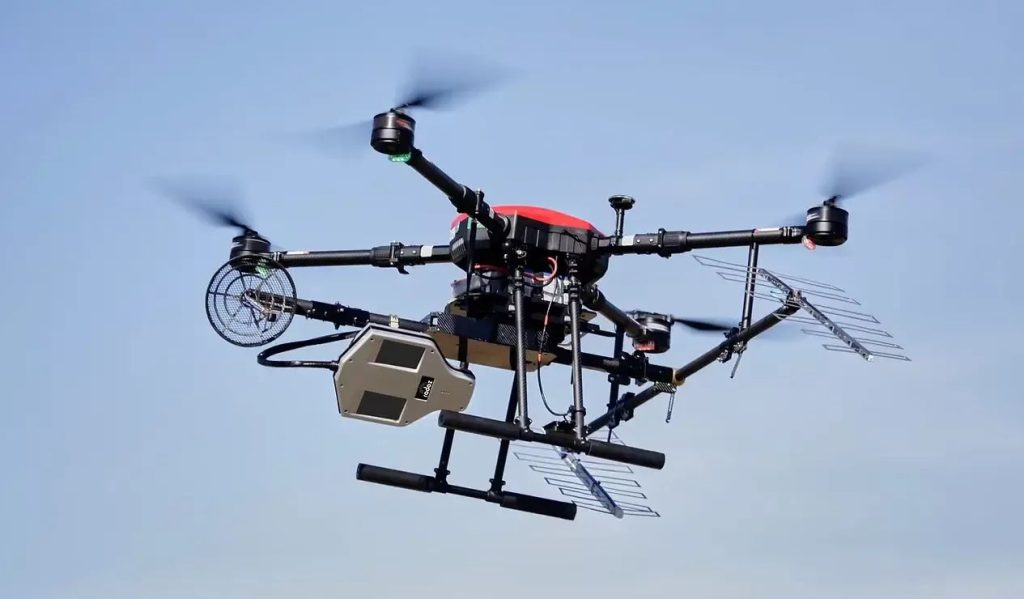
The basis for internationalization is the company’s proprietary RD350 synthetic aperture radar (SAR), a compact unit weighing only five kilograms that operates aboard a small drone. According to Radaz, it is the only radar in the world to operate simultaneously in three different bands, C, L, and P. “This is what gives our solution its groundbreaking character,” says Ikedo.
The bands are frequency ranges in which the radar functions. The C band allows it to identify the groundcover in an area, such as the top of a cane field or the canopy of a forest. The L band enables information to be captured at the ground level and a few centimeters below it, providing data on the terrain, water springs, and whatever else is there.

“The tandem work of these bands yields interesting results. When you combine the C and L bands, you can measure biomass, tree volume, and soil humidity,” explains Ikedo. The P band shows what lies underground, from 10 to 20 meters deep, and a depth of as much as 120 meters has been reached to meet a specific need.
Established in 2017 with a focus on research and academics, Radaz devised its RD350 by looking at large-scale synthetic aperture radars from past decades, which had to be loaded onto aircraft or satellites for use. In developing its product, the startup set out to broaden the use and democratize access to this technology, according to Ikedo.
“When you have a 100-kilogram radar that can only be hauled by aircraft or satellites, many segments are left unserved because that is too costly. Just getting a plane up in the air will cost you serious money,” the commercial director points out. Radaz worked on miniaturizing the radar and eventually arrived at its current product. The radar’s five-kilo weight includes its antennas and structure. The “cherry on the cake,” as Ikedo puts it, was the P band and the ability to employ the three bands together.
The unit has myriad applications. The commercial director mentions it is used in the agroforestry industry to detect anthills. “Instead of wasting ant killer by spraying it all over an area, you focus on where the anthill is,” he exemplifies. Its purposes include finding mineral deposits, mapping out beaver burrows, finding missing persons and skeletons, detecting oil pipes and taps made by thieves, and inspecting mining dams.
According to Ikedo, in Brazil, the RD350 is mostly employed by research centers, but also in industries such as agroforestry and mining. In other countries, research is also the main purpose, including studies on volcanoes, forests, geology, precision agriculture, etc. “Radaz has been essentially an exporting business,” the commercial director asserts.
Radars for the UAE
The relationship with the United Arab Emirates came about in 2021. Radaz’s clients in the country include the Technology Innovation Institute (TII), which operates more than ten radars by the Brazilian company. Ikedo notes that the relationship is built on deep trust, and Radaz develops technologies on demand for the TII. Because the TII focuses on tech innovation, the radars are employed for a wide range of purposes. Ikedo mentions a few, such as finding water pipes and conducting research at archaeological sites.
The new Radaz branch in the UAE, more specifically in Abu Dhabi, is expected to open this or next month, according to Ikedo. “Our goal is to launch operations out there in order to be closer to TII, our client, to be able to have technicians and engineers supporting projects locally, and eventually, of course, to expand operations even further,” he says. The company does not rule out having manufacturing operations in the Arab country down the road.
A leap in revenue
The year of 2025 should be one of milestones for Radaz, which launched a new headquarters in May in the city of São José dos Campos, where its other unit is also located, and is on its way to more than doubling its 2024 revenue number of BRL 17 million (USD 3 million). According to Ikedo, although the company does hope to boost sales in Brazil, its 2025 growth outlook is mostly underpinned by export, with sales deals closed and some in the pipeline for this year, plus the prospect of doing more business in the UAE.
Radaz is currently run by the accountant, CEO and board chairman Norivaldo Corrêa Filho alongside a team with a solid academic background, including João Roberto Moreira Neto, the chief engineer and board member, with a degree in Electronic Engineering from Brazil’s Aeronautics Institute of Technology (ITA, in the Portuguese acronym) and a doctoral degree from the Technical University of Munich.
Also in the team are the technical director, partner and cofounder Laila Fabi Moreira, who holds a degree in Electrical Engineering from the Pontifical Catholic University Católica in Campinas (PUC-Campinas) and master’s and doctoral degrees from the Campinas State University (Unicamp); and the software development director, partner and cofounder Christian Wimmer, with a degree in Physics and a doctoral degree from the University of Regensburg.
Translated by Gabriel Pomerancblum
