


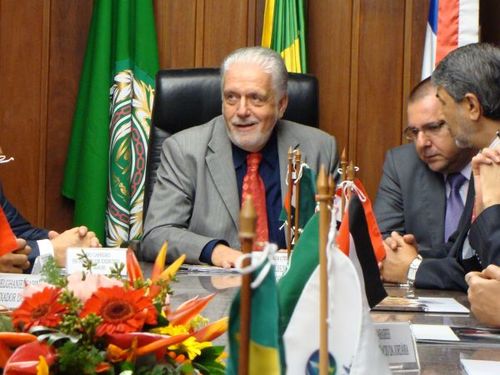
Salvador – Businessmen from Bahia should visit Arab countries in 2014. A business delegation started being articulated on Thursday (31) between the Arab Brazilian Chamber of Commerce and the Federation of Industries of the State of Bahia (Fieb) during the Bahia – Arab Countries Economic Forum. The meeting included businessmen from Bahia and the Council of Arab Ambassadors in Brazil, which promoted the visit to Bahia.
According to the CEO at the Arab Brazilian Chamber, Michel Alaby, the trade delegation should be promoted next year, with a small group of businessmen from Bahia. “It is possible for trade relations between Brazil and the Arab countries to increase,” said Alaby. Still on Thursday, the proposal was presented by Alaby to the governor of the state of Bahia, Jaques Wagner. He said that he should head the delegation if he is not hindered by the electoral agenda next year.
“Businessmen do business, but the presence of a state governor in an international delegation is a guarantee to businessmen who aim to invest,” said Wagner. Bahia exported less than US$ 70 million to the Arab countries in 2012 and imported US$ 997.3 million, mainly in oil products and fertilizers. According to Wagner, the state has invested in the attraction of foreign companies. Over the last six years (since he was inaugurated), said the governor, 400 companies have installed plants in the state and 100 expanded or modernized their units.
Prior to the meeting with Wagner, the businessmen from Bahia and the Arab diplomats participated in a forum at Fieb, where they also discussed investment. Representatives of 20 companies from Bahia interested in exporting or maintaining trade relations with Arab companies participated in the event. At the meeting there were companies in the sectors of architecture, building, cocoa export, logistics and services, among others.
Culture and Trade
At the meeting they had with the governor of Bahia, the ambassadors discussed the creation, in Salvador, of an Arab Culture House, as was discussed on Wednesday (30) with the mayor of Salvador, Antônio Carlos Magalhães Neto (DEM). Wagner supported the idea and suggested that the ambassadors choose real estate in the historic centre of Salvador to install the Culture House. The governor of Bahia also suggested the promotion of an “Arab week” in Salvador, with a typical cultural programme and preparation of recipes from the Arab cuisine.
To Alaby, the establishment of the Arab Culture House and the promotion of a business delegation from Bahia will be the first steps to foster bilateral trade between the state and the countries of the Middle East and North Africa.
Still on Thursday, the diplomats visited the Public Archives of Bahia, where texts written in Arabic by Muslim African slaves who wanted to free their peers in the Malês insurrection, in January 1835, resulting in the death of many of the rebels, are stored. The texts exhibited by the Bahia archives are mostly excerpts from the Koran, the holy book for the Muslims. The slaves carried these texts in small pockets in their clothes as amulets to protect them. The texts in power of the Bahia archives are part of legal cases condemning the slaves who survived the revolution.
At the end of the visit by the ambassadors of the Council of Ambassadors, the dean of the diplomats and ambassador of Palestine, Ibrahim Alzeben, said that the meetings were positive and should result in future business. “This visit was good both in the economic and investment sense, as well as cultural and social. We identified partners, spheres of interest, common roots. One of the most important results is the possibility of establishing an Arab Culture House in Bahia in cooperation with the State and City governments,” he said.
The visit included the ambassadors of Palestine, Sudan, Algeria, Egypt, Oman, Qatar and the Arab League and the business attachés of the embassies of Mauritania, Saudi Arabia, Morocco and Jordan. The ambassadors of Kuwait and Tunisia participated in the Wednesday meetings, but on Thursday they returned to Brasília to present their credentials to Brazilian president Dilma Rousseff. With them, the diplomats of Morocco, Iraq and Lebanon also met with the president, but did not travel to Bahia. The trip also included the Foreign Trade vice president at the Arab Brazilian Chamber, Rubens Hannun, and the head of the Middle East department at the Brazilian Foreign Office (Itamaraty), Carlos Leopoldo.
*Translated by Mark Ament
