


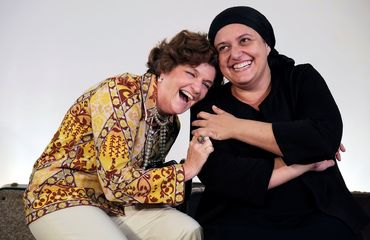
São Paulo – They are two ladies. Marion is a Maronite Christian from Lebanon, and Ester an Egyptian Jew. Both arrived in Brazil in their teens, one of them already married and the other soon to marry. Both are cooking kibbeh for a wake. The kibbeh ran out, and more is needed.
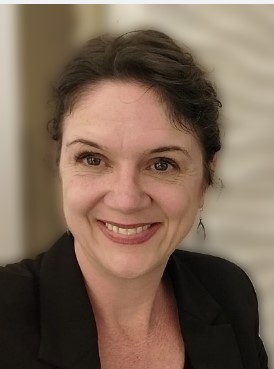
This is the principal setting for the comedy play “Brimas,” set to premiere on Friday (26) and show until September 11 at São Paulo’s Teatro J. Safra. The actresses Simone Kalil and Beth Zalcman, who wrote the play and are also staging it, took inspiration from their own grandmothers, who immigrated to Brazil from Lebanon and Egypt in the early 20th century.
“I had a strong desire to deal with the joy, the achievements of the Lebanese people,” says Simone Kalil, adding that Beth also wanted to tell the story of her grandma. The conflation of their desires bred the script and this iteration of the play. “Those matriarchs are very strong; they become etched in their families’ histories,” says Kalil.
The characters, as well as their real-life inspirers, have different religions, but myriad similarities, like the strong family ties, a sensibility for food, and the joie de vivre. “The similarities far outweigh the differences,” Simone Kalil asserts.
The play opens with the two actresses serving kibbeh to the audience. It’s a wake. “And people eat a lot at wakes,” Kalil explains, stressing the symbolism involved: “To give food is to give love and tenderness.” But the kibbeh runs out, and Ester and Marion find themselves having to make more.
As they get to work, they reminisce on the stories of their lives, like the ocean journey to Brazil, after hearing a piece of advice in their homelands: “when you get to Brazil, keep walking in a straight line and you’ll find the brimos,” says Kalil. Out of Rio de Janeiro’s Praça Mauá square where immigrants used to disembark, a straight-line walk will get you to the street market known as the ‘Sahara,’ where Arabs and Jews go about their trade.
While they make the kibbeh, they laugh, they cry, they pray for their grandsons and trade family stories. But the play is not about storytelling – they actually stage each of the moments. Simone Kalil tells that she and Beth took their cue from actual facts. The only thing that’s not real is the meeting of the two grandmas; in reality, they never met.
The play’s name, “Brimas,” references the way Arabs pronounce the word “primo” or “prima,” which is Portuguese for male or female cousin – they have a hard time with the letter p. It’s also a reminder of the fact that the Middle East peoples have several shared features.
The play has been staged before in Rio de Janeiro. According to Simone Kalil, it appeals to people from the Jewish and Arab communities, but also to the general public, whether or not they descend from immigrants. “In Brazil we’re all immigrants, and people identify even when they are not directly connected with immigration,” she says, adding that the play is about family, grandmothers, food, and that everyone has a mother, a granny, or an aunt to reminisce about.
Directed by Luiz Antônio Rocha, the play has travelled to several cities since its premiere in November 2015. It was nominated for the Shell Theater Prize in the Best Script Category.
Quick facts
“Brimas” Theater play (comedy)
August 26 to September 11, 2016
Teatro J. Safra
Rua José Kryss, 318 – Barra Funda – São Paulo – SP
Friday, 9:30pm; Saturday, 9pm; Sunday, 7pm
Price: From BRL 30 to BRL 70
Buy online: Compreingressos
For additional information call (55 11) 2626 0243
*Translated by Gabriel Pomerancblum
