


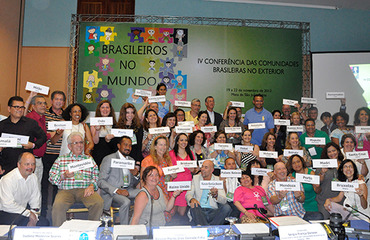
São Paulo – The reality of Brazilians living abroad will be the topic of debates by representatives of these communities in May in Salvador, Bahia. Around 30 people coming from different cities in the world where there’s a large concentration of Brazilians will attend the 5th Brazilians in the World Conference, which is organized by Brazil’s Ministry of Foreign Affairs (Itamaraty). The meeting is scheduled to May 17 to 20.
Set to attend the conference are the spokespersons of the Citizens Councils, groups of Brazilians that are organized in cities in which there are large communities and that work side by side with Itamaraty. According to minister Luiza Lopes da Silva, director of the Consulate and Brazilian Abroad Department, the topics to be discusses come from the community’s demands.
Among the topics covered, for instance, are issues regarding education, such as classes for the children of Brazilians, teaching of Portuguese and supplemental exam for young people and adults living as expats, social issues such as the fight on violence against women, children custody, the situation of elderly Brazilians living abroad, among others.
Also on the agenda are issues relating to social security and labor, facilitation of remittances and the opening of accounts in Brazilian banks while living abroad. Milder issues, such as the encouragement of associativism among Brazilians in other countries, with the creation of the Citizens Councils, and the incentives to Brazilian artists abroad will also be discussed.
The conference works as just a large meeting and doesn’t hold any lectures. Each topic is addressed with the participation of the spokespersons of the Citizens Councils and of the representatives of branches of the government, such as ministries of Education and Labor, that are experts in the topics. “It as a very practical nature to it”, says Silva.
According to the minister, there was an improvement since the beginning of these works with the Brazilian communities abroad. “In the first conference we just simply received demands”, she says. But, according to Silva, as the councils begin to solidify themselves, they started to work in a partnership with the Brazilian government. This way, alongside the communities, lectures are organized on topics of interest and that interfere in the day to day of Brazilians abroad, such as labor issues and others.
There are around 50 Brazilian Citizens Councils in cities abroad. But, according to Silva, due to the government’s budget, only 30 spokespersons were invited to travel. Since some cities have several councils, some of them were cut. However, representatives of other councils or even other members of the same groups can attend if they pay themselves the travel costs. Observers are also allowed to participate, which is normally the case with academics and researchers, says the minister.
The 1st Brazilians in the World Conference was held back in 2008. The meeting begun to be organized as part of the government’s effort to search for a better communication channel with Brazilian communities abroad, and from this effort also came the Citizens Councils. “We are very happy with this channel”, says the minister. These groups are formed in the cities where there are large concentrations of Brazilians and each council chooses how it will appoint its spokesperson. In the Arab world, there are councils in Beirut, Lebanon, and in Dubai, in the United Arab Emirates. One council has just been created in Riyadh, Saudi Arabia.
*Translated by Sérgio Kakitani
