



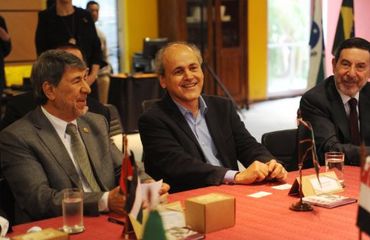
Curitiba – The state of Paraná is a major poultry exporter to Arab countries as it is, but it wants to boost sales nonetheless. They said so to the Arab ambassadors who are on a mission in the state, during a meeting at the local trade board, Associação Comercial do Paraná (ACP), in downtown Curitiba. The ACP arranged a meeting between the diplomats and local executives this Thursday afternoon (13).
At the meeting, delegates from Organização das Cooperativas do Paraná (OCP), a pool of cooperatives, said Arab countries should send a mission in the early months of next year to witness how its members go about poultry production, and then OCP personnel could travel to Arab countries. OCP comprises 295 agricultural cooperatives in Paraná, with seven poultry slaughtering facilities among them. With capacity building up, the organization is keen on increasing exports to Arabs, superintendent Robson Mafioletti told ANBA.
The state of Paraná slaughters 4.5 million chickens a day, 2 million of which are handled by Ocepar-affiliated cooperatives. Mafioletti explains that they perform halal slaughter, which complies with Muslim rules, and that this is the product that gets shipped to Arab markets. Ocepar’s cooperatives also sell other items to Arab countries, including sugar and coffee. Mafioletti made the invitation to the ambassadors and then spoke with the dean of the Council of Arab Ambassadors in Brazil, the Palestinian ambassador Ibrahim Alzeben, to follow through with the idea.
The meeting with the diplomats at the ACP headquarters was attended by an executive from poultry company Aurora Alimentos. The company’s Logistics coordinator Flávio Werner was there seeking business opportunities. According to him, the Middle East, which is Aurora’s third biggest buyer, buys 150 containers’ worth of poultry and poultry products a month. The company has one office in Paraná, one in Mato Grosso do Sul and 13 in Santa Catarina, where its headquarters are located.
The meeting was a chance for local businesspersons to find out more about the peculiarities of Arab markets, which were covered by Arab Brazilian Chamber of Commerce CEO Michel Alaby. He mentioned important points when it comes to doing business with Arabs, such as being patient in closing a sale. He also went over the most traded products between Brazil and Arab nations, and gave an overview of ocean shipping routes.
ACP interim president Glaucio Geara said Paraná has a lot to offer, considering its relevance in national production of soy, maize, wheat and other grains, as well as in animal-based food products. “Our agro-industry boasts the most up-to-date slaughtering facilities in the country, and they are long-time suppliers of poultry to Arab countries,” he said, adding that the local cooperatives are also key suppliers of Arab countries.
More than trade
At the ACP meeting, dean Alzeben planted a Paraná pine tree in a pot at the organization’s invitation. He was glad to do it. The Paraná pine is the local equivalent of our own olive tree, and it symbolizes peace. Those who visit us are invited to plant olive trees,” the ambassador asserted. Alzeben stressed the friendship and immigration ties that bind the state and its capital Curitiba with the Arabs. “If you doubt that, all you have to do is go to downtown Curitiba and see the Arab architecture,” he said regarding the Arab heritage that local buildings contain.
The Curitiba population of Arab descent was the topic of a meeting between the ambassadors and the city’s mayor, Gustavo Fruet (a member of PDT party), this Thursday (13). Fruet welcomed the diplomats alongside city councilman Paulo Salamuni (a member of PV), the majority leader in the City Council who is of Lebanese descent. “Curitiba is a cradle for Arabs”, said the councilman. The city is home for both long-time immigrants and refugees from Syria.
The mayor said that around 2,000 to 3,000 refugees are currently living in Curitiba, the majority of them from Haiti, African countries and Syria. Fruet believes that there are around 200 Syrians in the city and says that they arrive in a different and more favorable condition than the other refugees. “They often have a relative in the city, they are skilled workers, engineers, doctors,” he says.
According to Fruet, there are 750 children of these newly-arrived immigrants studying in Curitiba’s public schools. He talked about what the city offers to these refugees, such as food, basic Portuguese courses and later on more technical, in-depth courses, plus help with diploma certification, finding jobs, healthcare and openings in schools for the children.
Curitiba
The mayor told the ambassadors about the city’s features and said Curitiba has the country’s highest healthcare scores, the best fiscal balance and the third highest investment volume. But he also said the city has lost 40% in revenues with the current crisis. “We have high expectations for the country’s recovery and the improvement of structure of Brazilian cities,” said Fruet.
Ambassador Alzeben said that Arabs recognize the importance of Curitiba. “Curitiba’s fame has gone beyond Brazil’s borders,” he said. He praised the welcoming of refugees by the city and encouraged the initiative. “May you open up your city and your state to embrace these people who needs caring and work,” he said. Jordan’s ambassador, Malek Twal, suggested that cooperation between Arab cities and Curitiba be encouraged as a way to build closer ties between the peoples.
The mission of ambassadors visiting Paraná includes Alzeben and Twal, plus the ambassadors of Kuwait, Ayadah Alsaidi, of Libya, Khaled Dahan, of Egypt, Alaa Eldin Roushdy, of Sudan, Ahmed Elsiddig, of Mauritania, Wagne Abdoulaye, of the Arab League, Nacer Alem, and the chargés d’affaires of the embassies of Morocco, Mohamed Boulmani, and of Tunisia, Nada Bem Naceur. Also taking part in the mission is the Arab Chamber vice president of Foreign Affairs, Osmar Chohfi, and the third secretary of the Brazilian Foreign Ministry’s Middle East Department, Jaçanã Ribeiro.
*Translated by Gabriel Pomerancblum and Sérgio Kakitani
