



São Paulo – A group of Brazilian companies of the defense sector will attend for the first time the fair Security Middle East Show (SMES), in Beirut, Lebanon, on September 8 to 10th. The last edition took place in 2011. According to data from the Brazilian Association of Defense and Security Industries Materials (Abimde), set to attend the fair are the firearms manufacturer Taurus, the ammunition company CBC, the non-lethal arms manufacturer Condor, BCA, of armored equipment and fabrics, Índios Pirotecnia and MK Logistic.
Abimde’s technical director, Armando Lemos, said to ANBA this Wednesday (12th) that Brazilian companies have been going to events in the Arab countries and that companies from the Middle East have been attending fairs in Brazil.
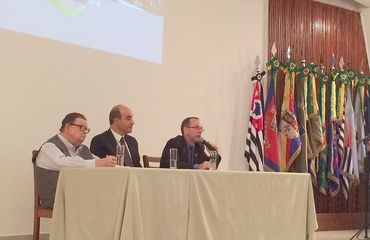
“The Middle East market is a priority to us and we already attended other fairs in the region. The products demand is varied, but noticed that they are looking for suppliers that aren’t from the United States or the European Union. They want to reduce their dependency”, said Lemos, after the presentation of a study ordered by Abimde about the potential of the defense sector for the Brazilian economy.
The survey was done by the vice-director of the Department of Economy, Management and Accounting of the São Paulo University (FEA-USP), Joaquim Guilhoto. The survey shows that in 2014 the Defense sector managed R$ 202 billion (US$ 58 billion), worth 3.7% of the Brazilian Gross Domestic Product (GDP). This percentage doesn’t include only investments but also spending of public and private institutions.
From this total, the study show, R$ 110 billion (US$ 31.6 billion) refers to activities of defense and security. Included in this calculation are costs with national defense, federal security, state-level security and private security. The last one managed R$ 31 billion (US$ 8.9 billion) in 2014.
Another R$ 71 billion (US$ 20.4 billion) are the result of defense service activities, such as food and distribution. Industrial areas that supply the defense sector generated R$ 8 billion (US$ 2.29 billion), and primary activities, such as inputs, added another R$ 13 billion (US$ 3.73 billion) in the total.
Guilhoto said that the study focused on compiling economic data, however, investments in defense and technology in the sector generate results that not always translated in financial gains. “The results are immediate, since they generate gains for the economy itself, but also as project and technologies are developed they can be adopted for civilian use”, he said.
Abimde’s presidente, Sami Hassuani, said that the study could help the sector and the Brazilian government choose the best areas for investment. He added that if projects that currently depend of government support were to be implemented, they could inject more resources in the Brazilian economy and increase in up to 2% the impact that the sector has on the GDP.
Hassuani said that among the potential markets for Brazilian companies are the Latin American countries and other emerging nations.
The former Finance minister and economista Antonio Delfim Netto attended the event along Hassuani and Guilhoto. He said that to invest in defense is essential to the country and pointed out that Brazil has resources, such as water and oil, that “need to be defended”.
*Translated by Sérgio Kakitani
