



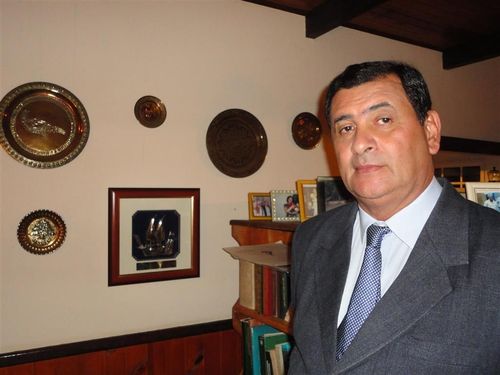
São Paulo – The works that Brazil’s emperor Pedro II had in his personal collection, in Arabic or about the Arabs, and which are now part of the collection of the National Library, in Rio de Janeiro, were catalogued by researcher and professor João Baptista Vargens and have become a book. The work, entitled "D. Pedro II, o primeiro arabista do Brasil?" (Emperor Pedro II, Brazil’s first arabist?), was released about one week ago by Vargens’ publishing house, Almádena, specialized on books about Arabs.
Vargens is a professor in the Arab Studies Area at the College of Language and Literature at the Federal University of Rio de Janeiro (UFRJ). He worked on the research about the emperor’s library after getting a scholarship from the National Library for studies about the institution’s collection. The work was developed two years ago and took about one year for completion, between mid-2010 and mid-2011. Vargens found 151 books.
Emperor Pedro II was a lover of Arab culture and travelled to the region several times. For this reason he had a large bibliography on the matter. Apart from identifying the works within the Library, the professor read and summarized them. He then catalogued them as: fiction, history, impressions on trips, Arabic, medicine, religion, zoology and botany. Apart from the list of books and their descriptions, Vargens also wrote an introduction explaining the emperor’s interest in the Arabs.
Most of the works found by the researcher are in French. Among the works collected by Vargens are “La poésie árabe atne’-islamique”, by René Basset, “Pelayo: an epic of the olden Moorish time”, by Elizabeth Beach, “La Novela del Egito. Viaje imaginário à la aperture Del Canal de Suez”, by José de Castro y Serrano, “Historia verdadera del Roy Dom Rodrigo”, by Tarif Abentárik Abulcacim, and “Voyage de l’Indie a la Mekke”, by Kérym Abdoul, among others.
Vargens presented his work in the form of a report at the end of the period and decided to publish it in catalogue-book form so as not to keep it restricted to the collection of the National Library. He believes that the work should generate interest mainly among specialized audiences, like those interested in Arabism and scholars. “There are also many people interested in Emperor Pedro II, and I discovered that he has a fan club,” said Vargens to ANBA.
Emperor Pedro II fostered Arab immigration to Brazil and even visited Egypt, Jordan, Lebanon and Syria, between 1871 e 1888. Due to his interest, even for learning the language, he translated the first 140 pages of the "Arabian Nights" straight from the original. After the Proclamation of the Republic, in 1889, and the emperor’s exile, in France, he donated his personal library to Brazil’s Historic and Geographic Institute.
According to information written by Vargens in the book, in the 20th Century, due to the precarious state of conservation of the volumes, the books were incorporated into the collection of the National Library. They, however, are spread out in the sector of General Works and Rare Works, and this demands special attention. Vargens discarded some from his research as they did not cover the topic proposed and also those on Ancient Egypt.
Author of books on Arabic and Islam, as well as having translated and organized the publication of several Arabic and Portuguese publications, Vargens won the Unesco-Sharjah award for Arab Culture last year. The award was promoted by the (Unesco) and the government of Sharjah, in the United Arab Emirates, to honour people and institutions that promote Arab culture. He should also receive, this month, the King Abdullah International Translation Award, in the Individual Translation Efforts category. The award is offered by the King Abdulaziz Public Library, in Saudi Arabia.
The book about Emperor Pedro II should be on sale at bookshops in Brazil in the near future, but for the time being it may only be acquired at the Almádena publishing house (contact information below).
Service
D. Pedro II, o primeiro arabista do Brasil? (Emperor Pedro II, Brazil’s first arabist?)
Commented catalogue on books in the Arab culture collection that belonged to the emperor, currently found in the collection of the National Library
Author: João Baptista de Medeiros Vargens
Editora Almádena
Pages: 80
Almádena contact information
Site: www.almadenaeditora.com
E-mail: [email protected]
*Translated by Mark Ament
