


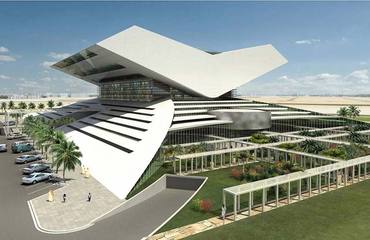
São Paulo – Engeprot, an engineering company owned by a Brazilian, is helping build the Mohammed bin Rashid Library, the biggest cultural project underway in Dubai, in the United Arab Emirates. The building is shaped like a book and spans 66,000 sqm. It will offer 4.5 million print, digital and audio titles, and is expected to welcome 42 million people a year, the local press reported.
Engeprot is owned by Omar Khaled Hamaoui, of Rio Grande do Sul, Brazil, and by the Emirati Suhail Hilal Bin Tarraf. It is based in Dubai and has an office in Abu Dhabi. The company specializes in projects and execution of prestressed concrete structures. Work for the Dubai library is ongoing, Hamauoi told ANBA by email.
Construction work began in September 2016 and should be completed by mid-2018, Emirates News Agency (WAM) has reported. The collection will include 1.5 million print books, 2 million e-books and 1 million audio books, making it the biggest library in the Arab world, and the one with the world’s largest e-book collection, WAM said.
Engeprot has completed approximately 250 projects in the UAE, with a combined built area of over 6 million sqm. Many of the buildings are of local and international fame. Besides the Mohammed bin Rashid Library, the company is currently involved in another major project: Silicon Park, a smart city in Dubai comprising commercial, residential and hotel space.
Projects under Engeprot’s belt include the Oasis Mall, from 2007, the economic and business center Business Park North & South, from 2008, and Rashidya Metro Car Park, a parking lot adjoining the Dubai Metro’s Rashidya station, from 2009. Presently, it is also doing work at the Fattan Towers building complex and at the Privé by Damac hotel. Overall, it has 18 ongoing projects, spanning roughly 1 million sqm, according to Hamauoi.
The Brazilian business owner said Engeprot plans to double its size by the end of this year. “The UAE market is promising right now, and we hope to help with its expansion,” said Hamauoi. The company has done work in Saudi Arabia and is currently active in two medium-sized projects in Oman. “We intend to increase our market share in Oman as well,” the engineer asserted. But apart from that, the plan is to focus exclusively in the UAE.
Hamaoui established Engeprot in the UAE in 2004, and by October it had embarked on a fairly large project at 100,000 sqm. At first it was a four-partner outfit, with one partner from Lebanon and one from Palestine, plus Hamaoui and Tarraf who still run the business. Hamaoui believes Engeprot succeeded due to a combination of factors: its demonstration of knowledge and professional experience, demand from the market, and the economic advantages of the technologies it employs.
But how did it manage to survive after so many years? According to Hamaoui, it was mostly through determination and persistence, plus the fact that it has something else to offer. The Brazilian business owner is of Lebanese descent and speaks Arabic. He says the language does help in doing business, but that all contracts and communication in the UAE are done in English.
Omar’s story
Prior to setting foot in the UAE, Hamaoui owned a construction company in Brazil. He started out with Esbelto Engenharia, in 1989, with Gerson Geovani Pozzobon as a partner. They worked on projects in Santa Maria and other cities in Rio Grande do Sul. In the late 1990s the company relocated to Cascavel, Paraná, where it took on bigger, more complex projects. Then, the business specialized in prestressed concrete design and execution, and changed its name to Engeprot – Engenharia e Protensão Ltda. Then the company moved again, this time to Curitiba, Paraná.
At that time, Hamaoui’s wife Dalal Hamdan worked in Marketing with the company. She was the one who envisioned the UAE’s potential for the technology that the company worked with. “After studying the market for over two years and finding out that a sheikh who collected cars was about to build a garage building for his collection, Dalal had the idea to reach out to him,” Hamaoui recalls. Dalal found out that the Arab Brazilian Chamber of Commerce was planning to go to the building industry expo Big 5 in Dubai for the first time, and that it was looking for businesses that had something new to offer.
Engeprot made the list and joined the expo. “The big thrust for us to get in was provided by the Arab Chamber’s full support, especially from Michel Alaby and Andréa Uhlmann; that was key to us,” he says. Alaby is the Chamber’s CEO and Andréa, who passed in 2014, was the Marketing manager. At the Big 5, the market proved very promising, so Hamaoui and Dalal decided to set up the business in the United Arab Emirates.
Life among Arabs
Hamaoui celebrated his 13th year of living in the UAE on March 13th. He finds the country very safe and a good place to live in. He notes that all people enjoy the same rights and duties when it comes to the law. “They are striving to adjust the laws and social rules in order to provide comfort to the people who live here,” he says, adding that since the UAE is a young country, there will always be some situations that need adjusting. “They are seeking out what’s best around the world to adapt it locally,” he explains.
The Brazilian business owner feels integrated. He has good native friends with whom he interacts well. “Generally speaking, they’re people who focus on family and personal values. They don’t care how much money you have. They’re always willing to help out, and they love all things Brazilian,” he says. He’s in a barbecue group whose members even include sheikhs. “My heart is still Brazilian, but I feel like staying much longer, if God permits. I have three children and I encourage them to stay in Dubai when they are ready to begin their careers.
The engineer lists a number of reasons why the UAE is a good place for companies like Engeprot, such as the professionalism, a very high work volume, his contact with businesses and highly-skilled professionals from around the world, the simple and fast conditions for setting up and running a business, the fact that the country is a paperwork-free logistics hub, and the attractive real estate market.
“My company’s going international gives it the credentials to operate in any market, even in Australia and Europe, in a relatively problem-free way,” he says, noting that anyone opening a business in the UAE must keep in mind that they’re in the middle of a region with over 1 billion looking to do business with the world. “The future of the world lies in between China and India, and it necessarily includes the UAE,” he asserts.
*Translated by Gabriel Pomerancblum
