



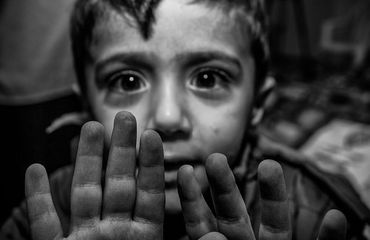
São Paulo – Pictures depicting the life of children and young refugees in the Middle East are on display in Fortaleza, Ceará, until February 18, in an exhibition called “Refugee Childhood”. It is a selection of 25 images taken by Karine Garcêz, a photographer from Ceará, in the Palestinian territory of Gaza Strip and also in Syria, Lebanon and Turkey.
With an interest in humanitarian issues, Garcêz started to study the issue of refugees during her major on International Relations. The conflicts in the Middle East also became part of her studies after she converted to Islam twelve years ago.
It was because of the new religion that Garcêz travelled for the first time to the region in 2012 to complete the Hajj, the pilgrimage done by Muslims in the city of Mecca, Saudi Arabia.
“Over there, I met the president of Al Wafaa, which is a NGO of Palestinians living in Europe,” says the photographer from Ceará. It was the president of the NGO that invited her to visit the Gaza Strip. “I spent 40 days there. First, in a hotel, and later in a family home. I kept taking photos, searching for information. I done it for my International Relations studies,” she explains.
In 2014, Garcêz came back twice to the Middle East, going through Syria, Turkey and Lebanon, countries in which she visited Palestinian and Syrian refugee camps. “During this period, I noticed that the children were the ones impacted the most. They suffered with malnourishment and the interruption of their human development. At the same time, they had a smile in their faces and played, tried to be children,” says the Garcêz.
“I heard testimonies of eight, nine-year-olds saying that they didn’t feel like children anymore because they had to work, since their parents were injured during the war,” says Garcêz. Determined to do something for those children, the Brazilian came up with the idea of holding an exhibition.
Most of the funds needed for the exhibition came from Garcêz, but she also had the financial support of some other people and of a culture and education organization. She was able also to establish important partnerships for the project, such as the one with the Architecture and Design students from the Federal University of Ceará (UFC) that turned one of the photos into a 3D wood work. “This turned the exhibition accessible to blind people. They can touch the photo,” she says.
And students of Media at UFC created a comic book in the web portraying the life of two refugee girls. The story discusses issues such as sexual harassment and the importance of education. A friend of Garcêz, who is an artisan, created dolls based on the refugee girls that can be purchased for anyone wishing to help them.
Among the memorable events in Garcêz’s trips to the Middle East, she points to a visit made to an United Nations (UN) school in Syria. “The children wanted to take pictures in front of some walls and I had to take the pictures that they wanted. From this school. I have more than 700 photos that I’m saving for a book,” she says. In all, the visits to the refugees resulted in over two thousand photos.
In addition to the dolls, the exhibition’s promotion material also includes magnets, post cards and bookmarks. They can be purchased at the exhibition in Fortaleza and also via Facebook at https://www.facebook.com/refugeechildhood/?fref=ts.
“With the money collected, I want to return [to the Middle East] and purchase school material to the children. The focus [of the exhibition] is on collecting funds for the education of these children,” says Garcêz.
Quick info
Exhibition Refugee Childhood
Where: Museu da Imagem e Som do Ceará
Av. Barão de Studart, 410 (next to Palácio da Abolição)
When: Tuesday to Friday, from 9 am to 5 pm; Saturdays, from 1 pm to 6 pm
Until February 18
Free of charge
*Translated by Sérgio Kakitani

