



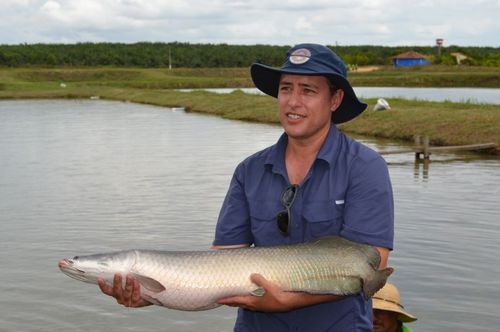
São Paulo – A project spanning seven different states in North Brazil is overhauling and improving the production quality of the Amazonian fish Pirarucu, with the purpose of increasing domestic consumption and exportation. Some 2,000 small- and medium-scale fish farmers in Amazônia, Amapá, Rondônia, Pará, Roraima, Acre and Tocantins are learning how to breed the fish in captivity under Projeto Estruturante do Pirarucu da Amazônia (the Amazonian Pirarucu Structuring Project). They grow approximately 130,000 fish between them.
The action is undertaken by the Brazilian Micro and Small Business Support Service (Sebrae) and the Brazilian Agricultural Research Corporation (Embrapa) and has been going on for five years. The fish are grown in excavated ponds in rural properties, and the two organizations assist the farmers with everything from the building of the ponds, which are dug into the earth, to breeding technologies, proper care and feeding, etc.
Sebrae’s national Fishery and Fish Farming coordinator Newman Costa explains that computer chips are implanted in the fish to prove that they were not taken from nature. In other words, they are not fished out of rivers. One of the purposes of the project was precisely to focus on captive breeding in order to prevent Pirarucu fishing on rivers, since the fish was threatened with extinction.
The fish are bred naturally. One male and one female are placed in each tank and start breeding, but Costa explains that Embrapa is already making tests in order for the process to take place in laboratories. At the onset of the captive breeding process, it takes knowledge and technology to identify males and females, since the fish’s gender is not easily detectable.
The project also works to advertise Pirarucu as a high-end cuisine option. “It’s one of the best freshwater fish,” says Costa. Pirarucu is considered a prime fish and can be eaten whole, carcass included, and it has no bones; it’s a fillet-friendly fish. As part of this strategy, gastronomy exhibitions and contests are held to raise awareness of the fish among journalists, chefs and restaurateurs across Brazil.
To ensure flavor and quality, the project insists on the use of adequate feed, which must contain 70% protein, since the Pirarucu is carnivore, and on observance of proper slaughtering guidelines, i.e. when the animal weighs 15 kg at most. Costa explains that this prevents the meat from growing old. “We’re talking Pirarucu, baby-beef style,” she quips. The farmers do not slaughter the fish themselves; they deliver it to authorized slaughterhouses instead.
Presently, two of seven states covered by Projeto Estruturante do Pirarucu da Amazônia, Acre and Rondônia, are authorized to sell to other states and abroad. The others are pending clearance from the federal government. There is a large-scale slaughterhouse in Rondônia state, Mar & Terra, which ships Pirarucu overseas. In Acre there is an industrial complex called “Peixes da Amazônia,” a public-private partnership that should begin exporting by the end of next year, according to Costa.
Sebrae’s national Fishery and Fish Farming coordinator claims there is a strong demand for the Pirarucu internationally, and that the project is revealing said demand. But she also notes that the fish can potentially sell a lot in Brazil as well. Despite being an Amazonian fish, it is well known in other countries for its prime character, flavor and quality. Pirarucu fish bred under the project also bear the federal government’s Selo Peixes Amazônicos (Amazonian Fish Label), attesting that they are from the Amazon and were produced sustainably.
*Translated by Gabriel Pomerancblum
