



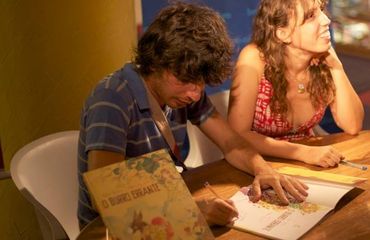
São Paulo – A travelling donkey that learns new lessons in the places it goes to, a bad wolf whose heart is softened by sheep, and a bashful old man who challenges even death itself. They all are characters created by Egypt’s Habib Zahra, who’s lived in Brazil since 2005 and devotes himself to writing children’s books.
“I had a travel diary that evolved into a fable, a genre I have been very particular to since I was little and one that’s very widespread in Egypt,” Zahra explains on how he created his first book, O burro errante (The wandering donkey), from 2012. The illustrations are provided by his wife, Spain’s Valeria Rey Soto.
Questioned whether his stories are Arab-influenced, he replies that some elements of his fables are inherited from stories he heard back in Egypt. "There’s a very strong tradition of oral culture in Egypt, and the main character in many of the fable stories that people tell is a donkey,” he claims.
Born in Cairo, Zahra left his homeland for the United States at age 16. After some time there, he decided to change things around and would up in Olinda, Pernambuco. He met Soto there and made the city in Northeast Brazil his new home.
When time comes to create, he bounces ideas off his wife, and they work on the story and the illustrations at once. Accustomed to writing from a young age, Zahra says he has no problems writing his stories in Portuguese. “I was taught to read and write in French. Arabic came later, and since Portuguese is very similar to French, I feel quite comfortable,” he points out.
The books are published with support from Fundo Pernambucano de Incentivo à Cultura (Funcultura PE), the primary mechanism to foster and spread culture in the state. Zahra and Soto also rely on funding to stage theater plays featuring stories from their books.
O burro errante and O último golpe do lobo mau (The bad wolf’s last hustle) were staged featuring actor and musician friends of the couple’s. The upcoming book O dia em que a morte sambou (The day that death did the samba), slated for release in late November, will be staged by shadow dolls, a technique whereby handheld dolls’ shadows are projected on a screen.
In April of this year, Zahra had a chance to show his work in his native country. “I went to Egypt to visit my mother and got invited to visit the Portuguese Language Department at Aswan University to speak to the students, who were already familiar with my book,” he says.
In Brazil, his books are sold at Livraria Cultura and other bookstores in Pernambuco. They are also available online: http://habib-valeria.com/loja/
*Translated by Gabriel Pomerancblum

