



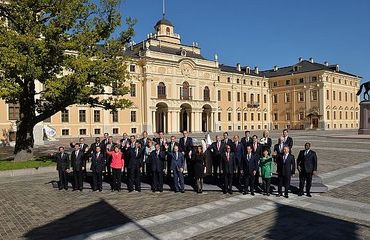
São Paulo – The G20, the group of the world’s leading developed and emerging economies, issued a communiqué this Friday (6th) in which it acknowledges that the global economy’s recovery is weak, and that measures are still needed that will lead to job creation and growth in different countries. The statement was released at the end of the bloc’s eight summit meeting in St. Petersburg, Russia.
“Global growth prospects for 2013 have been marked down repeatedly over the last year, global rebalancing is incomplete, regional growth disparities remain wide, and unemployment, particularly among youth, remains unacceptably high. Despite our actions, the recovery is too weak, and risks remain tilted to the downside,” the communiqué reads.
To the G20, the “main challenges to the economy” are weak growth, persistent unemployment, fragmentation in Europe’s markets, implementation of the banking union, slow growth of emerging countries, low private investment levels, high public debt-to-Gross Domestic Product (GDP) ratios, uncertainty regarding fiscal policies, and imbalanced global demand.
As to emerging countries, the G20 communiqué warns that the low growth rates are in some cases a result of high capital volatility (dollar inflows and outflows), “tight” financial conditions, commodity price volatility, and “structural” domestic challenges.
One of the measures taken to fight the exchange rate effects was announced last Thursday (5th) by the Brics countries, i.e. Brazil, Russia, India, China and South Africa. The group will set up a US$ 100 billion fund which any of its member countries will be allowed to use for protection against variations in dollar flows.
Emerging countries are being plagued by high volatility in foreign exchange markets ever since the United States’ Central Bank (Fed) signalled that since country is showing signs of recovery, it should withdraw economic stimuli, especially the system for repurchase of government bonds that injects money into circulation. The dollar has hiked against the currencies of developing countries.
This Friday, however, the United States have announced that 169,000 jobs were created in August, a lower figure than expected. In Brazil, the dollar was down 1.1% by 2:28 pm today, and was selling for R$ 2.29.
The G20 has stated that its “immediate goal” is working to create jobs and promote growth in advanced economies, which should trickle down into the world economy. In the communiqué, the G20 also states its support to infrastructure investment projects announced by some countries, such as Brazil. In a press statement, the Organization for Economic Cooperation and Development (OECD) has also championed investment in long-term projects, such as infrastructure ones, for strengthening the economy.
In a communiqué also released this Friday, the managing director of the International Monetary Fund (IMF), Christine Lagarde, said there is still “much to be done” before the world economy is functioning well. Like the G20, she said actions for fighting the crisis must be coordinated by different countries, and asked for the measures taken by financial authorities to be “communicated clearly.”
The next G20 summit will be held in November 2014 in Brisbane, Australia. The group is comprised of Argentina, Saudi Arabia, Australia, Brazil, South Africa, Canada, China, France, Germany, Indonesia, Italy, India, Japan, South Korea, Mexico, Russia, Turkey, United Kingdom, United States and the European Union. These countries combined account for 90% of the world economy, and approximately 65% of the world’s population.
*Translated by Gabriel Pomerancblum
