



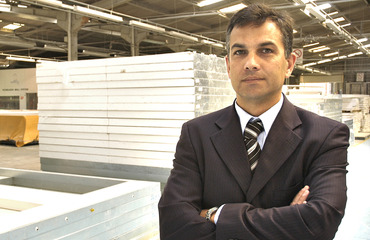
São Paulo – Brazilian company MVC will export 1,200 houses to Germany, which will be used to house Syrian refugees. This Monday (16th), the company sent by air the first house to the European country, according to the company’s general manager, Gilmar Lima. The houses measure 71 square meters with two bedrooms, are sent in modules to be assembled afterwards and will be located in Germany’s borders.
A consortium of German companies is importing the houses and will sell them to the government and to private companies to be donated to the refugees. The houses are built using a technology called Wall System, with a metal structure and sandwich panel of composite blades, reinforced with glass fiber and special cores that guarantee the thermal, acoustic and fire resistance performances. They are designed to face high and low temperatures.
“We have families that live in our houses for 12 years already without a problem. We have schools in Angola with more than eight years”, says Lima about the product’s performance and acceptance as a home. He says that the house is not designed for temporary housing and is made using high-end materials. Since it began operating in the sector, MVC already sold 250,000 square meters, with more than 50,000 of these sold abroad. In addition to houses, the company builds schools, day care centers and health centers, among others, with this technology.
The first house sent to Germany will be used for tests and for the training of the staff that will assemble them. Although the house is designed according to German legislation, Lima says that some small adjustments, if required, will be made based on this first unit. After this, it will be followed by a batch of 40 houses, then 50 houses and so on, until all the marks of 100 kits per month and 1,200 units until the end of the year are reached.
MVC believes in the project’s success and is getting ready to deliver 400 houses per month starting on May 2016 if the demand requires. The company’s capacity is of 10,000 houses and between 1,000 to 1,200 schools per year, according to its general manager. The company turned to the international demand due to the difficult economic period of the domestic market and is already negotiating with India, Argentina, Uruguay and Paraguay, in addition to talks with countries from the Caribbean and Africa. Lima says that the company is interested in several Arab countries.
MVC’s operations in the sector started with tests in Brazil’s south, in Caxias do Sul, a city that can be very cold but also reach high temperatures, with strong winds and rainstorms. Initially, they monitored three families living in the houses. But since the company knew it would face some resistance to the product for it being different of traditional options, it went searching for a market abroad and sold to Angola, Mozambique, Venezuela and the Caribbean. In Mozambique, up to ten bank agencies were built with the technology.
The dollar devaluation, however, lowered the competitiveness of the product for exports and MVC then turned to the domestic market. It made reception centers for Gol airline in airports and built 74 schools in the state of Alagoas. And now, with the dollar hike, the company will be able to sell abroad again. “If the dollar goes beyond BRL 3 we become extremely competitive”, says Gilmar Lima.
The company prepared to sell to the Brazilian market, but will use this potential to turn abroad. Lima says that it’s working domestically with projects that were already sold but that the default rate increased sharply and that the market is having trouble to pay.
The deal with Germany came by the indication of an executive that already knew MVC’s product. The kit being exported includes all the needs of a home, from walls to the hydraulic system, doors, windows and ceiling lining, among others. MVC’s houses or schools are sold for projects and can be either assembled by partner construction companies or by the company itself. They are still not available for the end consumer to buy it directly in retail.
MVC Building, which builds the houses, is a unit company of MVC Soluções em Plásticos, which, in turn, is owned by Marcopolo and Artecola. In addition to building, the company also owns other business unities in the auto, wind energy and agriculture sectors. The houses are built in the company’s plants in Caxias do Sul, Rio Grande do Sul, São José dos Pinhais, Paraná, and Maceió, Alagoas. But MVC also have manufactures plants in Catalão and Itumbiara, Goiás, Sete Lagoas, Minas Gerais, and Camaçari, Bahia.
MCV Soluções Plásticas
Phone: +55 (41) 2141 3200
Website: http://www.mvcplasticos.com.br/
*Translated by Sérgio Kakitani
