



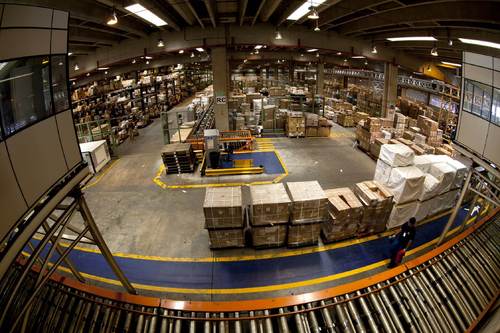
São Paulo – Since taking over São Paulo International Airport, in Guarulhos, on February 15th of this year, consortium GRU Airport has invested in modernisation of the passenger terminals to improve and expand the services and reduce criticism to operations. Another sector at the airport, cargo, is also undergoing transformation. Investment of R$ 45 million should increase storage capacity by 66.4% by 2017.
Changes in Guarulhos Cargo Terminal (Teca) should increase the cargo throughput from the 334,000 tonnes of 2012 to 556,000 in 2017. In 2013, throughput should total 365,000 tonnes. The GRU Airport estimate is that the growth should reach 11% a year, on average.
According to the cargo operations director at the airport, Marcus Santarem, Guarulhos cargo terminal has potential for growth and may also offer better services. “Before we managed the airport, it had a throughput of 32% of the air cargo in Brazil. That already took place when the effort to receive cargo was minimal,” said Santarem.
Guarulhos Airport was auctioned in February 2012. The consortium that includes Invepar (a company belonging to pension funds and construction company OAS) and by Airports Company South Africa (ACSA) paid R$ 16.2 billion for the concession of 51% of the airport for 20 years. The other 49% remain in the hands of the Brazilian Airport Infrastructure Company (Infraero), the state-owned organisation that manages Brazilian airports. In the same auction, Viracopos airport, in Campinas, and Brasília were also taken over, but for lower values.
The companies that took over the airports are expected to expand and improve services to supply passengers coming to the country for the World Cup in 2014. Among the improvements, GRU Airport will have to expand the terminal’s passenger capacity. In the cargo area, the challenges are others.
According to Santarem, the main complaint of clients is with regards to the level of services supplied by the Teca. “They complain about the delay for cargo liberation. It has already been as much as two weeks, but is now down to four or five days, on average,” said Santarem. Currently, 33% of the cargo at the airport is freed in up to 48 hours. The other 67% takes longer.
Many of the challenges do not depend solely on the airport’s management to be overcome. They depend on public organisations, like the Internal Revenue Service and the National Health Surveillance Agency (Anvisa), which are collaborating. However, the cargo sector in Guarulhos has another problem. Of the 96,900 square meters of the Teca, 1,920 square meters are occupied by lost cargo, or that which has been there for over 90 days without being collected. When that takes place, the Teca becomes the bailee and must store it. The volume of cargo in this condition is already lower than in February, when the company took over concession of the airport. One of the measures helping reduce the volume of cargo in bail was charging for the warehousing.
Teca has another 15,735 square meters occupied by the bankrupt VarigLog, the freight company that used to belong to Varig. “These products are in a strategic area of our warehouses, and we must use it,” said Santarem. The company is in contact with the VarigLog bankruptcy trust to free the space.
Growth strategy
While trying to make cargo space available, GRU Airport is making an effort to receive more goods on passenger aircraft. Currently, 84% of the aircraft landing in Guarulhos is for passengers and 16% is cargo aircraft. Of the total goods moved there, 70% are in passenger aircraft cargo holds. “Our idea is to expand the cargo volume without depending on freight aircraft,” said the commercial manager at Teca, Maria Fan.
Fan is not making this forecast solely considering the current flights arriving at the airport. When ready, passenger Terminal 3 will have six berths for the largest passenger aircraft in the world, the Airbus A380 and the Boeing 747-8. The cargo transport capacity of these aeroplanes is larger than that of the large aircraft that currently fly to Guarulhos. When still operated by Infraero, the airport was authorised to receive the A380, albeit outside peak times. Emirates Airline, from Dubai, and the German Lufthansa showed interest in flying the aircraft to Brazil.
GRU Airport hired a consultancy company to help identify and execute the necessary improvement at the airport. They also include the construction of a 2,000 square meter chamber with temperatures ranging from 15°C to 25°C to store goods that need a controlled environment, as is the case with medication. This chamber should be added to 16 other existing cold storage chambers.
Teca should also get a new cargo management system in future, connected to the system of airlines, to help with boarding, arrival, receipt and delivery of cargo. Santarem wants the Teca to know what cargo is in an aircraft before it arrives at the airport. “This is a way of taking better care of the product,” he said. The concession holder should also buy forklift trucks and equipment.
Santarem recognizes that the changes in Guarulhos should make the airport compete with Viracopos, in the interior of São Paulo. The Campinas terminal currently receives most of the cargo aircraft and is the second in participation in cargo throughput, second only to Guarulhos, with 25% of the total. He says that there is a chance of some companies uniting their cargo and passenger operations in one airport. “Viracopos is also investing to receive more passengers. It is natural for us to seek cargo transporters,” said Santarem.
*Translated by Mark Ament
