



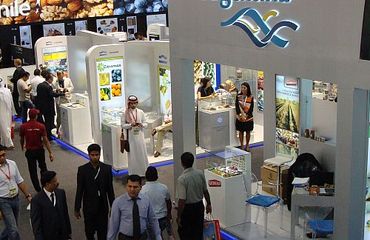
Dubai – Holding themed editions of the Gulfood fair is an avenue that may be explored by the organization in upcoming editions. According to the fair’s director Mark Napier, the biggest challenge facing the Middle East food industry fair is finding room for all interested parties. “It is a problem, albeit a good one,” he said this Wednesday (26th), in an interview to ANBA, while visiting the Brazilian pavilion at the event in Dubai, United Arab Emirates.
The Brazilian participation is organized by the Brazilian Export and Investment Promotion Agency (Apex-Brasil) and the Arab Brazilian Chamber of Commerce. Napier believes Brazilian companies may feature in even greater numbers in the fair, but he warned: “I think Brazil can bring in more companies, but it will become increasingly harder and challenging to accommodate them all due to lack of space. We have no room left, and perhaps we will need to break the fair down into different editions for confectionery items, savoury items and so forth.”
A final decision on the matter has not been made yet. This year, 2,500 exhibitors were left out. The area covered was the same as last year: 114,000 square metres.
According to the director, the exhibitors have said this has been the best edition yet. The first edition was held 28 years ago. “We will have over 80,000 visitors. This edition will surpass even the most optimistic of expectations,” he said. Figures concerning the total volume of deals closed at the fair are not available at this time, but Napier said it should exceed the initial US$ 500 million forecast.
He ascribed part of Gulfood’s success to Dubai’s being located between the North and South hemispheres, between the East and the West, and close to emerging markets. The executive added that the city has prepared itself for hosting major events.
“Dubai’s development was built upon three pillars: tourism, transportation and trade. These pillars have created a powerful flow of people. Investment in ongoing transportation projects amounts to US$ 8.8 billion, we have a vast number of hotel rooms available, and we are home to leading freight companies, as well as the Jebel Ali Free Zone. All of this ensures that global trade will pass through here,” he said.
He noted that Brazilian products are gaining ground and visibility at the Gulfood, due to the country’s strong food production capacity, and because Brazil is promoting its products overseas. Napier said the result of Brazil’s expansion is clear to see in the Brazilian pavilion.
Spanning over 1,000 square metres, the pavilion features 77 enterprises and a mezzanine where typical dishes are served. Napier said Brazilians are successful in the Middle East because its executives cater to a specific demand from Arab clients: halal production, i.e. in accordance with Islamic food production rules.
“Halal is synonymous with the Middle East, which is synonymous with Brazil. These types of products are made in large numbers in Brazil, and as such they have become a brand that the people here can trust,” he said.
*Translated by Gabriel Pomerancblum
