


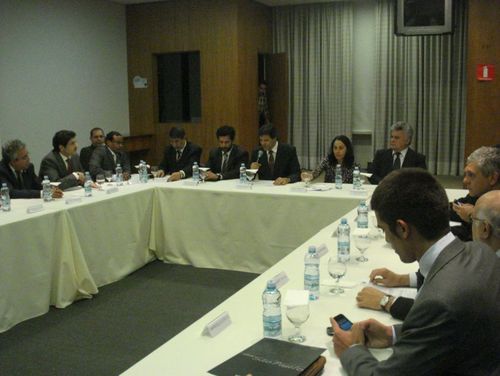
São Paulo – The mayor of São Paulo, Fernando Haddad, called for Arab country support to the candidacy of the city of São Paulo to host the Expo 2020, a universal exhibition that takes place every five years in different parts of the world and lasts six months. The mayor spoke to ambassadors of Arab countries and representatives of the Arab Brazilian Chamber of Commerce on Tuesday (26), at the São Paulo City Hall. The meeting was part of the agenda of diplomats in the city of São Paulo, which also included a meeting at the Federation of Industries of the State of São Paulo (Fiesp) and with executives at Bandeirantes communications group.
Apart from São Paulo, also candidates to host the Expo 2020 are the cities of Izmir, in Turkey, Ayutthaya, in Thailand, Yekaterinburg, Russia, and Dubai, in the United Arab Emirates. “We have great respect for the Emirates, but it is now time to bring the exhibition to Latin America,” said Haddad, recalling, before, in a relaxed atmosphere, that the city even has a greater Arab population than Dubai. The mayor placed himself at the disposal of the ambassadors to show them exhibition project which, according to Haddad, is a demonstration of the peace and diversity culture of the city. “I know that Arabs understand rational points, but that without passion, Arabs cannot move. So here comes a request from a passionate Lebanese,” said Haddad, who has Lebanese roots.
The ambassador of Palestine and dean of the Council of Arab Ambassadors in Brasil, Ibrahim Alzeben, stated that the decision on support would not be made there, but would be sent to each country represented. “You can be certain that this will be taken to the highest levels,” he said, regarding the request. Alzeben also made requests, in the name of the ambassadors, to the mayor of São Paulo, all turned to cooperation and culture. He invited Haddad to visit Arab cities and evaluate the possibility of establishment of sister city ties between some of them, and the city of São Paulo. The dean suggested that São Paulo could host several events, like a large meeting between Arab and Latin American cities and an economic forum between Brazil and the region, and that the city could also be the Arab culture capital in the country.
The president at the Arab Brazilian Chamber, Marcelo Sallum, who participated in the event, spoke about a project developed by the organisation for which he expects City Hall support: creation of the Arab Culture House in São Paulo, about which there have already been talks with the previous administration. He also told the mayor of São Paulo about the promotion of an agreement, some two years ago, between the Arab Brazilian Chamber and the Arab World Institute, in Paris, an initiative that may, according to him, bring exchange of experiences relative to the Arab world and Brazil.
At the meeting with ambassadors, Haddad spoke about his origins and about how the Arab presence is important to the city. “We have one of the largest Arab communities in the world in São Paulo that is participating actively in community life, be it in trade, building, politics, medicine…” he said, adding that Arab immigrants also brought to São Paulo their religiousness, through the Maronite and Orthodox Christians and the Muslims. “I am very proud of my raising,” he said. His grandfather, Cury Habib Haddad, became an Orthodox priest in Lebanon after becoming widowed and his mortal remains were buried in the Crypt of the Orthodox Church, on Vergueiro street, in São Paulo.
Fiesp
The ambassadors also had a meeting at the Fiesp, where they asked for a trade delegation, headed by the organisation, to their countries. Dean Alzeben said that this would be an important initiative for closer trade ties between São Paulo and the Arab nations. “To know each other mutually we need to exchange specialized delegations,” said the diplomat. Alzeben called for investment by the industry of São Paulo in the region, pointing out that the countries that lived the Arab Spring and wars need to be rebuilt. “We want to count on you,” he said.
Alzeben recalled, however, the diversity in the Arab world. “Some countries offer oil, others, market, others, land for food safety, and others need your investment,” he said. The ambassador of Palestine recalled that the Arabs also want to invest in Brazil, but that they find bureaucratic difficulties, like dual taxation and lack of agreements for protection of investment. “You need investment and we need investor safety,” said the dean.
One of the conclusions of the meeting was the need for creation of a committee to work on these matters, like the end of investment bottlenecks. “I am sure that together we can contribute much for the reduction or elimination of these bottlenecks,” said Marcelo Sallum, referring to the Council of Arab Ambassadors, the Arab Brazilian Chamber, Fiesp and the Brazilian Export and Investment Promotion Agency (Apex), all there represented. The vice president at Fiesp, Elias Haddad, who met the group, said that the meeting was one of the first of many he hopes to attend in future.
Bandeirantes
The ambassadors also met the president of Bandeirantes group, João Saad, his daughter, Daniela Saad, and the group’s executive vice president, Paulo Saad. The Saad family, which created the company, is of Lebanese origin. At the meeting, the diplomats asked for means of communication from Brazil to change their view of the Arab world, and their coverage that not always reflects the reality of these countries, and asked Bandeirantes group to play an important part in the process. “We have a task of clarifying what the Arab world is and here we have a broad and respected channel,” said the ambassador of Palestine, in the name of his colleagues.
The diplomats made a series of suggestions to João Saad, like the creation of monthly programmes about the region, the sending of journalists to the Arab world to present the countries and the opening of a Bandeirantes office in some Arab country. “Collect information directly in our countries,” pleaded the ambassador of Algeria, Djamel Bennaoum. The group’s president said he would study the possibility of setting up a base in an Arab nation and added that he would advise journalists to meet with the ambassadors to create a more direct channel of communication. “I am pleased to see how our ambassadors view the vital importance of this area of communications,” said Saad.
Apart from Alzeben and Bennaoum, the agenda of activities in São Paulo also included the ambassador of Sudan, Abd Elghani Elnaim Awad Elkarim, who is the deputy-dean of the Council of Arab Ambassadors in Brazil, the ambassador of Kuwait, Yousef Abdulsamad, the ambassador of Oman, Khalid Salim Al Jaradi, the ambassador of Egypt, Hossameldin Zaki, the ambassador of the League of Arab States, Bachar Yaghi, and the Business attaché at the Embassy of Morocco, Abdeslam Maleh, the Business attaché at the embassy of Jordan, Hasan Saraireh, the Business attaché of Tunisia, Merhez Ferchichi, and the Business attaché of the embassy of Mauritania, Ahmed Mahmoud Ould Ethmane. Also participating was Arab Brazilian Chamber CEO Michel Alaby, among other representatives of the organisation.
*Translated by Mark Ament
