



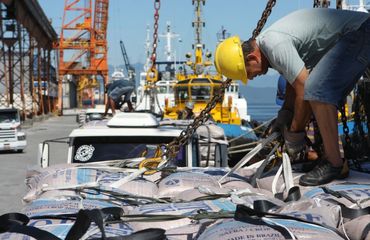
São Paulo – Brazilian exports increased to 11 Arab countries March-on-March, according to figures supplied by the Brazilian Ministry of Development, Industry and Foreign Trade and compiled by the Arab Brazilian Chamber of Commerce. Sales to all Arab countries were down 12.5% in March, to US$ 1.02 billion, and down 2.2% in volume, to 3 million tonnes. However, Egypt, Algeria, Libya, Jordan, Bahrain, Lebanon, Syria, Qatar, Palestine, Djibouti and the Comoro Islands increased their spending on Brazilian products.
Egypt topped the ranking of Brazilian product importing countries in March, at US$ 172.9 million. The country was also the leading Arab target market for Brazilian products during the month. The increase in shipments was driven by meats, up 100% to US$ 57.7 million, ores, up 11% to US$ 50.8 million, and sugar, up 260% to US$ 32.2 million.
Exports from Brazil to Algeria went from US$ 70 million to US$ 103 million, a 47% increase mostly due to sugar, up 17% to US$ 68.3 million, and maize, at US$ 13.3 million. In March last year, Brazil exported no maize to Algeria. Exports to Libya (US$ 61 million) were up 195% driven mainly by ores and sugar, and exports to Jordan (US$ 60.7 million) increased as a result of aircraft sales, which amounted to US$ 39 million.
Regarding the decline of exports to Arabs as a whole, the Arab Brazilian Chamber CEO Michel Alaby says Brazil has competitive issues. “Large corporations tend to enter into partnerships in order to manufacture products in these markets, as a result of the ‘Brazil Cost’ [i.e. the cost of doing business in Brazil],” he says. Alaby adds that presently, the domestic market is buying at attractive prices, and that causes companies to export less. He also notes that there is an embargo on Brazilian beef in place in some markets, such as Saudi Arabia and Iraq.
Overall exports from Brazil declined in March this year. Exports were down 9% March-on-March, from US$ 19.3 billion to US$ 17.6 billion. In the case of the Arab market, the decline in revenues was mostly a consequence of lower revenues from meat exports (-15.8%), sugar (-30%), ores (-5.76%) and cereals (-30.44%). Out of these items, ores only saw a decline in price, since the shipped volume increased. The volume shipped of the remaining products also declined. These four products rank among the most exported products from Brazil to the Middle East and North Africa.
Year-to-date through March, Brazilian exports to Arab countries were down 10.3% from the same period in 2013. In quarter one (Q1), export revenues stood at US$ 3 billion. Shipped volume was also down, by 15%. Saudi Arabia, Egypt and United Arab Emirates were the leading importers. Of them, only Egypt stepped up its imports Q1-on-Q1.
Brazilian imports of Arab products dropped this year, both in Q1 and in March alone, by 41% to US$ 586 million in the latter case. In Q1, the decline was lower, at 6.6%, to US$ 2.2 billion. Mineral fuels and fertilizer imports declined. These two are the main products imported by Brazil from Arab countries.
*Translated by Gabriel Pomerancblum
