


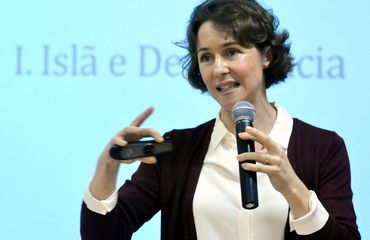
São Paulo – The refugee crisis in Europe, conflict in the Middle East and diverging interpretations of Islam are the result, among other factors, of the division of the world into East and West, said the historian Arlene Clemesha while delivering the lecture West and East – where schematisms and oversimplifications fail at the offices of the Arab Brazilian Chamber of Commerce, in São Paulo, last Tuesday night (8th).
The director of the Center for Arab Studies at the University of São Paulo (USP) argued that to divide the world is a flawed approach. She remarked that many Islamic countries are democratic, that there are varying degrees of democracy among them, and that freethinking is at the root of Islam.
Clemesha reminded the audience that Arab philosophers translated and interpreted the major Greek philosophers, and this allowed Europe to regain access to Ancient Greek thinking. “The earliest Arabic translations in existence are science-related. The Arabs even realized that translating a text based on its interpretation was the best approach,” she said, referring to the strides made by Arab and Islamic societies in their quest for knowledge.
Europeans tapped into the achievements and the progress made by Arabs, but at the end of the Middle Age they started denying Arab contribution as they sought to affirm their own European identity. From that point on, European translators set out seeking the roots of Greek thinking on their own. This denial led to a division between different worlds and cultures, the East and the West.
The questions that spawned such a division, the historian remarked, are reflected in our days. As a case in point, she mentioned the belief that the arrival of Muslim immigrants in European countries could put the European identity in jeopardy. “The same type of rationale was employed towards Jews in Europe. The notion that Judaism was widespread and had to be combated. Jews made up 4% of the German population [up until World War Two], the same rate as Muslims in European countries today,” she compared.
The historian noted that some European countries, like Germany and the United Kingdom, are making an effort to take immigrants in and integrate them into society. In France, on the other hand, there’s resistance. Clemesha also said the fact that the veil is banned in French schools drives Muslim girls away from pursuing an education, but not from their beliefs. “What can happen is that they will look for Muslim schools, and not those attended by all other students,” she pondered.
Clemesha pointed out that the perpetrators of the attacks to the French satirical magazine Charlie Hebdo in January of this year in Paris, studied in French schools and were raised in the suburbs of Paris. She said that these are examples that the segregation and social issues are the causes for radicalism. In France, says the historian, Muslims are 8% of the population, but 50% of the prison population.
The crisis of the Syrian, North and Sub-Saharan Africa refugees, who risk their lives to seek for asylum in Europe, is another example of the division of the world in different peoples. Still according to data presented by Clemesha, in all of last year, 280,000 illegal immigrants tried to enter Europe and 2,000 of them died trying to do so. Until August of this year, 350,000 people went to Europe, with 3,000 deaths.
Clemesha said that despite the refugee crisis becoming a huge issue in Europe, the European countries are not the ones receiving the larger flow of refugees. Turkey, Pakistan, Lebanon, Iran, Ethiopia and Jordan receive the larger number of refugees. The main countries of origin are Syria and Afghanistan.
Clemesha’s lecture is part of a cycle of lectures organized by the Arab Chamber. The lectures are admission-free and open to the general public. In the event, the historian was welcomed by the former director of the Arab Chamber and organizer of the cycle, Mario Rizkallah, and by the organization’s president, Marcelo Sallum.
*Translated by Gabriel Pomerancblum and Sérgio Kakitani
