



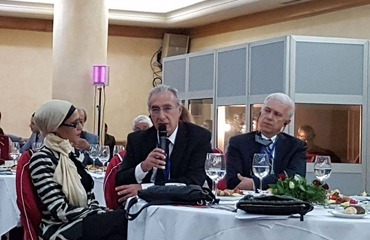
São Paulo – The vice president of Foreign Trade of the Arab Brazilian Chamber of Commerce and honorary consul of Tunisia in the city of São Paulo, Rubens Hannun, presented the Arab Chamber’s economic diplomacy expertise during his trip to Tunisia last week. Hannun was in the Arab country on October 3 and 4 and met with local ministers to discuss the work done by the Arab Chamber to improve relations between Brazil and Arab countries.
The Foreign Trade vice president discussed the merging of two important features of the work done by the Arab Chamber, which are diplomacy and economy. Diplomatic work requires knowledge of society, its challenges, the solutions that were found or achievements that were made, says Hannun, adding that trade, on the other hand, entails more practical issues, such as selecting the products to sell and buy, the costs and logistics.
“For a deal to be done naturally, you have to know both,” says the vice-president about trade and diplomacy. The work of the Arab Chamber, which masters both fields, fits this profile. Hannun highlights that in foreign trade, it’s important to be familiar with the culture, arts, lifestyle and even the other country’s sense of humor. He was invited by the Tunisian government to present the Arab Chamber’s know-how.
The honorary consul also talked about the works of the Brazil-Tunisia Business Council, created to achieve closer ties between the two countries, and to work for the agreements that the Arab Brazilian Chamber of Commerce has signed with Tunisian organizations such as the Tunisian Confederation of Industry, Trade and Handicraft (Utica), the Tunisian Export Promotion Centre (Cepex), the Foreign Investment Promotion Agency (Fipa) and the Agricultural Investment Promotion Agency of Tunisia (Apia).
The Arab Brazilian Chamber’s experience was retold in meetings attended by some 60 people, local and foreign, most of whom are involved with Tunisian diplomacy. Hannun explains that Tunisia has completed its political transition, and is now going about the economic one. “They are putting in a great effort towards making their economy more dynamic,” the consul told ANBA.
The country is also looking to export more and to pull investment in. During the meetings, Hannun also commented on the need to advertise Tunisia’s image and products in Brazil. The country produces a wide variety of goods, ranging from food products such as dates and olive oil to textiles and ceramics. According to Hannun, it is the top exporting country in North Africa.
During the trip to Tunisia, the Foreign Trade vice president took part in several meetings, in the cities of Hammamet and Sousse, which were also attended by the Tunisian ministers of Foreign Affairs, Khemaies Jhinaoui, of Development, Investment and International Cooperation, Fadhel Abdelkefi, of Industry and Trade, Zied Ladhari, and of Tourism and Handicraft, Selma Elloumi-Rekik.
Hannun also convened with other authorities, mostly at the meetings, including the Tunisian state secretary of Foreign Affairs and former ambassador to Brazil, Sabri Bachtobji, Fipa director general Khalil Laabidi, Utica board member Mohamed Kooli, the Ministry of Foreign Affairs’ CEO for consular affairs Fayçal Bem Mustapha and director of Diplomatic Protocol Meddeb Mondher, the president of the Sfax Chamber of Commerce and Industry, Ridha Fourati, the Foreign Businesses advisor to the Ministry of Foreign Affairs, Khalil Jendoubi, Utica vice president Hichem Elloumi, and Cepex president Aziza Htira.
The meetings on economic diplomacy were also held on occasion of the 60th anniversary of the Tunisian Ministry of Foreign Affairs, and the agenda included the Tunisia 2020 International Conference on investment, slated for November 29 and 30 in Tunis, where a new five-year plan for developing public and private investment will be disclosed. The country’s new investment code will also be presented to foreign executives.
*Translated by Sérgio Kakitani & Gabriel Pomerancblum
