


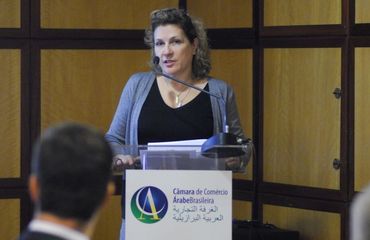
São Paulo – The Islamic finance market is currently worth US$ 1.5 trillion and will double in volume by 2018. The expansion and characteristics of this market create investment opportunities for Brazilian exporters and importers, said this Thursday (27th) the regional manager for Latin America at the National Bank of Abu Dhabi (NBAD), Angela Martins. She delivered the workshop “The Islamic financial market,” organized by the Arab Brazilian Chamber of Commerce for its members in São Paulo.
At the meeting, Martins outlined the main features of Islamic finance, the more common financing modalities, the differences from Western finance, and the opportunities they offer people and businesses. This type of financial transaction abides by the rules of the Koran. Charging interest on a loan, for instance, is prohibited.
One of the more widespread forms of investment is the murabaha. It allows a company or individual that wishes to buy a good but doesn’t have the money to resort to an investor. The latter pays for the product upfront and sells it in installments to the interested party, for a higher amount. Interest is not charged.
“This transaction could be done with a Brazilian exporter. He could sell the product to an Islamic creditor who could pay in cash and then sell it in installments to an Arab Buyer,” Martins said. “The goal is to prevent speculation from taking place,” she explained.
According to the NBAD’s manager, the main Islamic finances centers are the Gulf countries and Asia’s non-Arab Islamic nations, which is the case of Malaysia. Besides them, the United Kingdom, France, Australia, Russia and China are Islamic financial centers. The United Kingdom’s central bank, for instance, already issued sukuks, which are Islamic bonds, a measure also adopted by the North American Merril Lynch. “It’s very likely that more countries will take part in this industry. We have to prepare ourselves to also operate in this area”, said the executive.
Martins pointed out that Brazil already has the ability to attend to the halal food market, since it’s one of the main beef exporters to the Gulf countries. Besides, she noticed, Brazil will soon expand its portfolio of halal products within cosmetics and pharmaceuticals. “This knowledge of the halal market is already enough to get close to Islamic finances”, she adds.
Nearly 60 people from member companies of the Arab Chamber attended the workshop promoted by the organization. Trading companies, food producers, law firms and retail and investment banks were represented at the event. “It’s a new topic and we have to better understand how Islamic finances work. Today, we had the opportunity to improve our knowledge”, said the Arab Chamber’s CEO, Michel Alaby.
*Translated by Gabriel Pomerancblum and Sérgio Kakitani
