



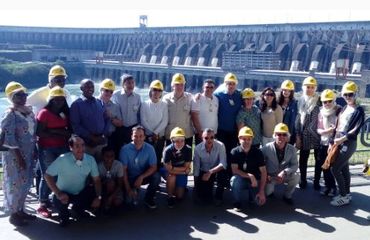
Foz do Iguaçu – Itaipu Binacional, the power plant set in the border of Brazil and Paraguay, is in the process of drafting a modernization plan, its Engineering superintendent Jorge Habib Hanna El Khouri told ANBA on Friday (14) as Arab ambassadors visited the facilities. According to Habib, the plan will take about a year and a half to complete, after which it will be tendered and then executed. Although estimates aren’t available, he believes the project could require USD 400 million in investment.
Habib and Joel de Lima, the assistant to Itaipu’s Brazilian CEO, welcomed the Arab diplomats, who are on a mission to the state of Paraná. The ambassadors had a short conversation with the executives and then went on to tour the hydroelectric plant’s facilities. Itaipu is a half-Paraguayan, half-Brazilian enterprise with 14,000 MW capacity set on the Paraná River.
Itaipu has already grossed the governments of Paraguay and Brazil roughly USD 10 billion worth of royalties. The project was born in 1973 after the two countries signed a treaty, and construction began in 1975. During the peak of construction, 40,000 workers labored on the site. The complex’s first unit went active in 1984, and the last one, in 1987. The plant supplies approximately 80% of Paraguay’s power needs and 15% of Brazil’s, the diplomats were told.
The Arab ambassadors witnessed the plant’s sheer grandeur first-hand. They walked up to where the Paraná River bed was before the dam was built. The gigantic concrete walls hold back a reservoir of 29 billion cubic meters of water, which flows in gradually and controlled through the plant’s pipes, setting the turbines in motion to generate power.
The diplomats also saw other areas of the plant, including the room where the Brazilian and Paraguayan electricity system are interconnected. The power exits the plant in high voltage and the Brazilian portion of it is transmitted to São Paulo, from where it charges the national interconnected system to supply the Midwest, Southeast and South of the country. All information and conversations at the site happen in Spanish and Portuguese, or else in an amalgamation of both, known as ‘portunhol’ (or Spaniguese), the tour guide said.
The ambassadors were impressed by the integration between two peoples that the plant symbolizes. On welcoming the visitors to Itaipu, Habib mentioned that there was a Brazil and Paraguay in 1860, and said the plant is a sign of peace. “It is possible to build peace despite a past of war,” he claimed. He added the 1960s witnessed a resurgence of tension between Brazil and Paraguay due to border-related issues. “Instead of a new war, they made a deal to build Itaipu,” Habib said.
Also in this conversation, the dean of the Council of Arab Ambassadors in Brazil and Palestine’s ambassador in Brasília, Ibrahim Alzeben, praised Itaipu. “You are an example of how to generate electricity,” he said. Just like the Arab diplomats visited the place, Itaipu Binacional welcomes tourists from all over the world every day. Since the visits to the hydroelectric plant started, around 20 million visitors already came to the plant.
The Itaipu executives exchanged gifts with the ambassadors and with the third secretary of the Middle East Department of Brazil’s Ministry of Foreign Affairs (Itamaraty), Jaçanã Ribeiro, who accompanied the visit to the state and to the power plant. Besides the ambassadors and chargés d’affaires of Palestine, Kuwait, Jordan, Libya, Egypt, Sudan, Mauritania, Arab League, Morocco and Tunisia, also joining the ambassadors in the activities in the state were the Arab Brazilian Chamber of Commerce’s CEO Michel Alaby and Foreign Relations vice president Osmar Chohfi.
In Foz do Iguaçu, besides visiting Itaipu, the delegation had a meeting with the mayor of the city, Irene Barofaldi (member of the PSDB party). In the capital Curitiba, there were meetings with governor Beto Richa (member of the PSDB party), with mayor Gustavo Fruet (member of the PDT party), with business owners at the Paraná Business Association (ACP) and with the local Arab community. The ambassadors also attended a dinner offered by the Arab Chamber this Friday. The Arab Chamber CEO believes the mission’s activities were very positive and mentioned that they generated results, such as the possibility of creating a center for Arab culture in the state and a cooperation agreement between the Arab Chamber and the ACP.
*Translated by Gabriel Pomerancblum and Sérgio Kakitani
