


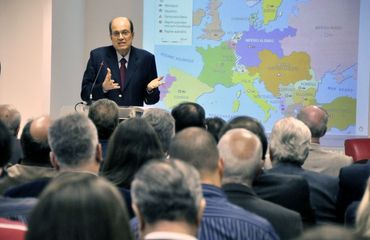
São Paulo – The conflict between Israel and Palestine and Syria’s civil war are challenges of complex solutions and apparently far from being resolved, according to assessment of the former, now retired, appellate court judge of the São Paulo State Court of Appeals, Paulo Eduardo Razuk. On this Tuesday (10) evening, the judge presented the lecture “The consequences of the First World War to the Near East” to directors, employees and members of the Arab Brazilian Chamber of Commerce, at the organization’s headquarters in the city of São Paulo.
The judge pointed out that the huge mistakes that turned the Middle East into a region of great instability are the result of the West’s influence in the region. “The interference of the West always brings nefarious consequences. Look at the invasions in Afghanistan and Iraq. The values are really different. You can impose values to other people”, he said. Razuk also stated that he doesn’t see a solution to the Israel and Palestine conflict due to the fact, among other reasons, that Israel has the unconditional support from the United States in defending its territory.
“In this talk I wanted to offer a symbolic contribution based on my interest in history. It’s essential for us to understand the present and avoid new mistakes”, said Razuk to ANBA at the end of his talk.
In his presentation, Razuk substantiated his opinion when he provided a context to events in the past that resulted in the current conflicts and challenges. He recalled the secret negotiation on the division of the region done in 1916 by diplomats François Georges-Picot, from France, and Mark Sykes, from the United Kingdom, known as the Sykes-Picot Agreement.
Another factor that already indicated the interest in influencing the politics in the Middle East was the letter sent by the British secretary for Foreign Affairs, Arthur James Balfour, to the leader of the Jewish community in Great Britain, Walter Rothschild, in 1917. In it, Balfour expressed the support of the British government to the establishment of a home nation for the Jewish people in Palestine. Both the Sykes-Picot Agreement and the sending of the letter by Balfour to Rothschild occurred during the First World War (1914-1918).
In 1919, the United States, United Kingdom, France and Italy organized the Paris Peace Conference, in which they stipulated the war punishments to Germany, defeated in the conflict. In that occasion, they also created the League of Nations, the organization that preceded the United Nations and had its rules constantly broken by the world powers. After these facts, the independence of several Arab territories followed: Iraq in 1921; Transjordan (region that includes Jordan) in 1922; Lebanon in 1943; and Syria in 1945. Palestine, however, didn’t achieve its independence.
Between the two great wars and the negotiations on the division of territories, said Razuk, Arab countries established secret deals with Israel, which didn’t result in an equal division of two independent states. Palestinians weren’t represented. Syria and Lebanon stayed under French rule until their independence, already in the Second World War (1939-1945), and Iraq, when it became independent, gathered in its territory people from different creeds: Sunni Muslims, Shiite Muslims and Kurds.
“I think it was an omission on the part of the Paris Peace Conference not to consider a territory for the Kurds. Kurdistan is anear-autonomous region in Iraq, with close to 20 million people, and a permanent source of friction”, said Razuk. The grandson of a Lebanese, he said that the solution for the conflicts is difficult and improbable in the current context, but pointed out that there is always the unexpected: “I didn’t think that I would see the Berlin Wall fall. And it did (in 1989, with the end of the Soviet Union)”.
Razuk’s lecture is part of the Lecture Cycle of the Arab Chamber, which each month welcomes an expert in a certain knowledge field. Past lecturers have included economists and historians. Attending this Tuesday’s event were the president of the Arab Chamber, Marcelo Sallum, the CEO of the organization, Michel Alaby, and the organizer of the Lecture Cycle and former director of the Chamber, Mário Rizkallah, in addition to other directors and vice presidents.
*Translated by Sérgio Kakitani
