



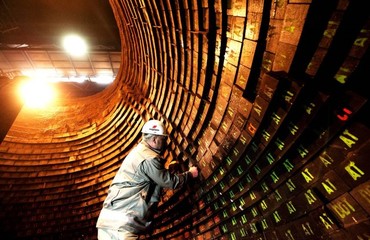
São Paulo – Magnesita Refratários S.A. has plans of opening a new office in the Arab world, in Bahrain, to meet a contract with steel mill Sulb Steel. The Brazilian mining and refractory and minerals industrial materials closed a deal recently with the Bahrain-based company for the supply of products for a five-year period, according to an interview via email to ANBA this Tuesday (28th).
Refractories are materials that resist to high temperatures. Magnesita manufactures these types of products, from standard bricks to ceramics, for the coating of equipment operating in high temperatures, particularly in steel, cement and glass mills. The company is leader in the refractories market in the Americas and serves more than 100 countries.
In the Arab world, besides the office that will be open in Bahrain, the company already has an office in Dubai and representatives working in Jordan, Saudi Arabia and Oman. Eleven countries in the region are among the consumers of its products and there are plans of expansion for the local market. “With the focus in the region being so new, the numbers aren’t that significant; however, we consider that this market will have a very important representativeness in the next few years”, said the company.
Magnesita exports for the Arab countries of Saudi Arabia, Bahrain, Qatar, Egypt, United Arab Emirates, Iraq, Jordan, Kuwait, Lebanon, Morocco and Oman. The Middle East and Africa account for 3% of the company’s revenues. Sales to Arabs started in 2013 with Bahrain and Saudi Arabia. According to the company, the market was opened after the implementation of technical and commercial support in the region with the Dubai office.
“Magnesita is in an upward trajectory in market opening in the Arab region and the plan is to continue to aggressively move forward in the steel and cement markets. The main motivation element is the growth in steel and cement output in the region”, said the company. For Magnesita, Saudi Arabia is a differentiated market among the Arabs due to its potential, with a large industrial park in the steel and cement sectors.
Magnesita exports to the Arab market basic and aluminous refractories to steel and cement plants and to the non-ferrous sector. The majority of the businesses with these countries are generated by bidding processes. The field’s large groups in the Arab world are state-owned companies or those operating in joint ventures with governments, according to Magnesita. The company says that they are, however, open to long term contracts and have an open vision for shared earnings. “And it makes them interesting to Magnesita since we are leaders in cost per performance (CPP) contracts.
The company intends to expand abroad but doesn’t make estimates. “Magnesita continues to be committed to its long term strategy, always seeking the expansion of its operations, efficiency and growth gains, being in key markets or new ones”, said the company, but reminding that its future outlooks are dependent of external factors, that are beyond management, such as market behavior, with its current and future political and economic situation.
Currently, the majority of Magnesita’s revenues come from South America: 44.1%. North America accounts for 26.8%, Europe for 18.1% an Asia for 8%. Other earnings come from the Middle East and Africa. Its operations are not based only in Brazil. The company has 28 industrial plants and mining facilities, with 16 located in Brazilian states, three in Germany, three in China, one in the United States, two in France, one in Belgium, one in Taiwan and one in Argentina. Magesita’s output stands at 1.4 million tons per year.
It’s a private company, publicly traded, with shares traded in the BM&FBovespa’s New Market in Brazil and via ADRs in the United States. It was founded in 1940 after the discovery of a magnesite deposits in Brumado, Bahia state.
In Bahrain
Sulb Steel, with which Magnesita closed a business contract, is a joint venture between the Bahrain-based Foulath group and the Japan-based Yamato Kogyo, according to information in the company’s website. The joint venture has two industrial plants, one in Saudi Arabia and another in Bahrain and it manufactures processed steel products. Foulath has a 51% share with Yamato holding 49%.
*Translated by Sérgio Kakitani
