



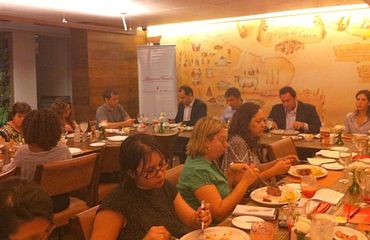
São Paulo – The Muslim countries in the Middle East and the nations in Southeast Asia have been the leading export targets for meat packing company Minerva Foods this year. at a meeting with journalists held by the company this Monday (9th), in São Paulo, the company’s chairman Fernando Galetti de Queiroz has said these markets should keep growing in 2014, and will remain among the company’s foremost clients.
“We are very much focused on emerging markets, especially places like China and Southeast Asia, one of the world’s most thriving areas right now. The Middle East has been highly relevant to us as well, because we are becoming increasingly specialized in halal slaughter (in accordance with Islamic law) and in the Muslim markets,” said Queiroz. Although the company’s business with these regions has prospered, Queiroz does not rule out the possibility of having good export results to Latin America, the United States and Europe. These regions, said Queiroz, are reducing the size of their herds, and thus imports are poised to go up.
On the other hand, noted Queiroz, South America is a “key player” in meat production, because it has grazing land, large numbers of baby calves, and the capacity to meet the demand. The Minerva company is based in Barretos, in the state of São Paulo, and owns 11 units throughout Brazil, Paraguay and Uruguay.
Export revenues
Although 2013 is not over yet, Minerva executives believe export revenues should account to 70% of total revenues this year. The remaining 30% will originate from domestic sales, mostly to small and medium wholesale businesses. According to the vice president for Finance at Minerva Foods, Edison Ticle, export revenues are expected to answer to an even higher rate in 2014 than this year’s 70%.
The reason for the increased share of exports in total sales is the fact that the US dollar is currently appreciated against Brazil’s real. This year, the dollar was up nearly 15%, and dollar sales on the futures market indicate that the currency will rise even further next year.
Queiroz and Ticle have also said that the company’s international operations may grow and reach new markets in 2014 as a result of an agreement signed in September, by which the International Finance Corporation (IFC), acquired a 3% stake in Minerva. The IFC is the World Bank’s investment arm. The Minerva executives believe this deal may make it easier for the company to break into some markets, because the IFC has several offices in developing countries, which are its target markets.
“Our partnership with the IFC opens up new vistas in other countries, and we should see lots of opportunities in Asia and Africa. They have offices in developing countries, and these may leverage new business opportunities,” said Queiroz.
For next year, the company is also expecting Brazil’s Administrative Council for Economic Defence (CADE, in the Portuguese acronym) to approve the deal whereby Minerva takes charge of company BRF’s bovine operation. The deal was announced in early November, and provides for the BRF to cede its bovine meat processing plants in the state of Mato Grosso in exchange for a 15% stake in Minerva. Queiroz said, however, that BRF’s plants will not be included in next year’s budget, because the company does not know when the CADE will approve the deal. The council has one year to assess the deal.
*Translated by Gabriel Pomerancblum
