



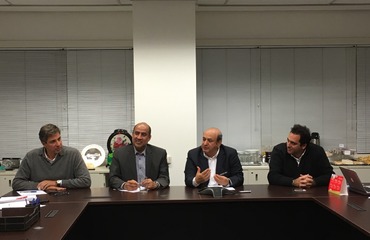
São Paulo – Executives from the meat packing company Minerva and from the Saudi Agricultural and Livestock Investment Co. (Salic) have said this Friday (29th) that the primary goal of the agreement between the two corporations signed at the end of 2015 is to increase food distribution in Saudi Arabia and the Gulf and ensure food security in the region.
In December last year, Salic invested BRL 746.5 million (USD 212.2 million) in a 19.95% stake in Minerva, a Brazilian company based in Barretos, São Paulo. The executives spoke this Friday with a small group of journalists in São Paulo state’s namesake capital to provide details on the deal. ANBA was there.
Salic’s CEO Abdullah Aldubaikhi said the company aims to ensure food security in Saudi Arabia and the Gulf countries, but added that Brazil is a major international producer of commodities, and therefore a potential destination for investment.
Salic is already active in grains production in Ukraine and Canada, and in sugar production in India. “These investments are a form of diversification, but they are also a chance to minimize the risks to our country. Now, we are also in Brazil,” said Aldubaikhi.
Minerva and Salic’s executives also said they have expansion plans for the Saudi distribution market, but declined to provide details on upcoming steps due to confidentiality issues. Nonetheless, Salic board member Mohamed Abdulaziz AlSarhan said Saudi distribution still needs work. “It is somewhat underdeveloped, and Minerva could be a template for improving it,” he asserted.
Salic is an arm of the Public Investment Fund of the Kingdom of Saudi Arabia (PIF), devoted to investing in agriculture. The fund is worth roughly USD 2 trillion and invests in numerous industries.
Minerva’s chairman Fernando Galletti de Queiroz said the activities and interests of Salic and Minerva are complementary. “We see skills and knowledge that complement one another. We hope to go beyond the production chain in one part of the world. And what we hope is that both sides will be stronger. One of the avenues is distribution in Saudi Arabia,” he said.
Betting on Brazil
Aldubaikhi said that Salic considered the possibility of investing in other Brazilian meat processing companies, but opted to negotiate and sign the agreement with Minerva due to its governance, performance, presence in the Middle East – its largest market abroad –, and also because the company has great knowledge in the halal market, of products manufactured according to Islamic guidelines.
Salic’s CEO also said that the current political and economic crisis that Brazil is facing don’t change his plans for the partnership with Minerva. “We are not thinking short-term. We are thinking long-term,” he said.
AlSarhan said that the company is “monitoring” the crisis, but said that Brazil is stronger than it. “We are not looking only to the immediate future. If, for instance, Minerva’ shares suddenly go up, we won’t sell them and then leave the deal. It’s not that. Brazil is large, an international player and political problems do occur. If we think long-term, the outlooks are positive,” he said.
Queiroz and Minerva’s financial director, Edison Ticle, said that when the deal started to be discussed, in June 2014, the Brazilian situation wasn’t as critical as today, but from then on the negotiation didn’t stop because of the worsening of the crisis.
The executives also said that the resumption of Brazilian beef imports by Saudi Arabia is an opportunity to explore that specific market even more. Last year, the Saudis lifted an embargo to the product that had been in place for three years already. Ticle and Queiroz said that the Saudi market is growing and that the potential is there to expand the volume of per capita beef consumption.
Salic’s CEO pointed out that, with the absence of the Brazilian product in the Saudi market, they had replaced it using suppliers from Australia and New Zealand, which offered a product of excellent quality, but an expensive one.
*Translated by Gabriel Pomerancblum and Sérgio Kakitani
