



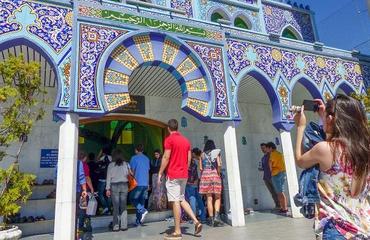
São Paulo – The Curitiba Islamic Art and Culture Museum opened a year and a half ago in the Paraná state capital, but is awaiting donations to round off its collection and open its doors on a six-day-a-week basis. The venue was created by mosque Mesquita de Curitiba Imam Ali Ibn Abi Tálib, in a space adjoining the temple. It currently features only items from Iran and opens on Sunday. For now, visits must be scheduled beforehand.
“We’d like to have pieces from all of the Arab countries,” says the mosque’s religious director Gamal Oumairi. He called on ambassadors from Arab countries for donations during a meeting in Curitiba, at the Paraná Trade Board last October, and talks should be ongoing. But the museum is open to receiving objects from other organizations or businesses, so long as they match the profile of Arab and Islamic art.
“This the first permanent Islamic art and culture museum in Brazil,” Oumairi told ANBA. The director concedes that the place is empty right now, since it features only some 25 objects, including metal, marquetry, wood and iron pieces, photographs and Persian rugs with verses from the Koran, the holy book of Islam.
The purpose of the museum is to spread Islamic culture and religion. One of the goals is to help end the stigma that Islam is a religion of extremists or barbarians. “Muslims do have a culture, they have art,” he says. Oumairi believes art is a way of showing who the Muslims are. According to him, just like the Muslims, Arabs are stigmatized, and the idea is to help change that around.
In its work to promote Islamic religion, the museum should function as a complement to the mosque, which welcomes large numbers of tourists. According to Oumairi, the mosque Imam Ali Ibn Abi Tálib sees some 30,000 visitors per year, plus school and university students. The museum also offers group visits on weekdays, upon prior scheduling, and it opens on Sunday from 10:30 am to 1:30 pm. Once the collection grows bigger, the plan is to open from Tuesday to Sunday.
Currently, students and other types of visitors, such as elderly tourists visiting the mosque get to watch lectures on the principles and practices of Islam. Subjects include monotheism, the pilgrimage to Mecca, the Sharia rules, etc. Oumairi explains that many questions come up regarding self-proclaimed terrorist group the Islamic State (ISIS). An explanation is given on what ISIS is, what its roots are and what sets it apart from Islamism, which denounces extremism and is a peaceful religion.
An Iranian businessman living in Paraná provided financial support for the museum, Oumairi explains. The venue’s opening ceremony in June 2015 was attended by Imam Hassan Ahmad Al-Khomeini, the grandson of ayatollah Ruhollah Khomeini, who led the Iranian revolution and founded the Islamic republic in the country. He was visiting Paraná on the occasion.
Quick facts
Visits or donations:
Museu de Arte e Cultura Islâmica de Curitiba
Rua Kerelles, 383 – Bairro Alto São Francisco – Curitiba – PR
Phone: +55 (41) 3222-4515
Email: [email protected]
*Translated by Gabriel Pomerancblum
