


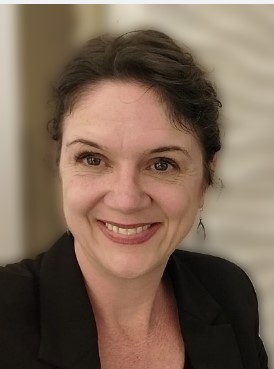
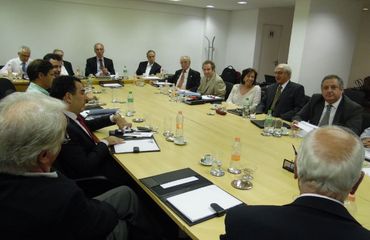
São Paulo – The Arab Brazilian Chamber of Commerce’s 2017/2018 administration had its first board meeting on Monday (6), led by incoming president Rubens Hannun. The agenda included an event-packed schedule for the next three months, and strategies to help drive business deals for member companies, as well as to strengthen the Chamber’s role in fostering trade between Brazil and Arab countries.
The newly-appointed president called on board members to focus on the social aspects of Brazilian-Arab trade. He stressed the social responsibility that supplying food to the Arab world entails, since those countries are unable to engage in large-scale production due to their climate. “Brazil must prioritize selling food to the Arab world because they need it.”
According to Hannun, social responsibility also plays a part, for instance, in medical cooperation efforts whereby Brazilian health institutions and professionals share their technology and knowledge with Arab countries. Additionally, he mentioned the social commitment involved in building Brazil’s image in the Arab world and vice versa. “How can we uphold our social responsibility in Brazil towards the Arab community that lives here and those who are arriving now?” he inquired.
The new president urged board members to consider the imponderable when envisioning Brazilian trade with the Arab world and the Arab Chamber’s work in the long run. He noted that the world is witnessing events that until not long ago were deemed unthinkable, and therefore the organization must also prepare for an unpredictable future.
Board members suggested several initiatives and avenues for the Arab Chamber to take. The February-April schedule was also a key topic.
Packed schedule
One of the main events in the Chamber’s plans for February in Brazil is the Breakfast with Arab Chamber Members, on the 15th, featuring former Bradesco economist-in-chief Octavio de Barros, Arab Chamber CEO Michel Alaby and Hannun himself as speakers.
On the international front, the Chamber will join the Gulfood expo in Dubai from February 26 to March 2, with additional appointments including a meeting with Brazilian executives focusing on the foodstuffs market in Arab countries, a roundtable panel with journalists, meetings with local authorities, etc.
February should also see technical missions to Arab countries such as Saudi Arabia, the UAE and Egypt, plus several activities with Arab diplomats in Brazil, among them a meeting with the Council of Arab Ambassadors, reception of incoming ambassadors, visits by diplomats to different states of the country, and celebrations of countries’ national dates.
In March, the Arab Chamber will welcome a UAE minister to Brazil, carry out cultural activities to mark the National Day of the Arab Community, and sponsor lectures on Arab markets in cities across Brazil.
The board members also discussed the schedule for April and part of May, including Arab diplomatic missions and delegation trips to Brazil, meetings with organizations representing the Arab world, lectures and panels for the general public and for members only, a trade mission to North Africa, trade shows in Brazil, etc.
Plans
Actions involving Brazil and the Arab countries will be plenty, and the new administration displays a willingness to do its best. “Our Marketing department will spare no efforts in supporting these projects, leveraging and promoting the Arab Chamber brand, further cementing our brand in Brazil and the Middle East and making clear what the Arab Chamber does,” Marketing vice president Riad Younes told ANBA, adding that the department’s plans for 2016 and 2017 were outlined last year alongside Hannun, then in the capacity of Foreign Trade vice president.
Treasurer Nahid Chicani, another member of the new administration, said he expects the actions to open up new vistas for the Arab Chamber. Vice president of Administration Adel Auada asserted that striking a balance between revenue and expenditure will be a challenge in what should be a tough year for Brazil. “It’s a day-to-day project; there’s no such thing as a year’s project. Each day is a workday,” he said.
Foreign Trade VP Ruy Carlos Cury regards the Arab market as a solution for the Brazilian industry. “Domestic consumption is slumping. Our industry is operating well below its capacity. I believe in the importance of having Brazilians investing in exporting to the Arab world. Business owners need to realize that encouraging foreign trade does not entail expenditure, it’s an investment. We will succeed in increasing the share of Arab countries in our total exports,” said Cury.
Osmar Chohfi will hold the seat of International Relations VP. He has good expectations regarding the new administration and Brazilian-Arab ties. “It is of the essence that the Arab Chamber be prepared to join the Brazilian government’s plan of endorsing foreign trade promotion,” highlighting the need to work for partnerships with other chambers, and to invest in trade between Brazil and the Arab countries.
*Translated by Gabriel Pomerancblum
