


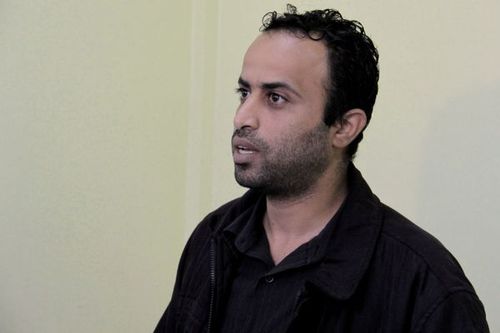
São Paulo – The opportunity to grow professionally, aid people who have no access to basic health and the good salary offered by the Brazilian federal government’s Mais Médicos (More Doctors) programme attracted general practitioner Tareq Abuiyada to the country. At 34 years of age and married to a doctor from Rio Grande do Sul, he became interested in the programme that promises to deliver better quality health to poorer Brazilians.
Abuiyada was born in Gaza Strip, in Palestine, and lived in the country until the age of 19. He had always wanted to be a doctor and started realizing his dream when he got a scholarship to study in Cuba. He lived on the island until 2010. That year, Abuiyada spent two months volunteering in Haiti, to assist those injured by the earthquake that killed over 200,000 people.
In Cuba, Abuiyada met his wife, general practitioner Fernanda Lanes, who is from the city of Santana do Livramento, in Rio Grande do Sul, which borders with Rivera, in Uruguay. Until September, Abuiyada lived in the city in Rio Grande do Sul and worked in the neighbouring country. This routine resulted in his having greater contact with Brazilian patients, as many cross the border to be treated at Uruguayan health centres, instead of being treated in Brazil’s Single Health System (SUS). Both countries have an agreement that allows for this exchange.
“I treated many Brazilian patients. I liked them and identified well with them. Working in Brazil stimulates me, as there is a lack of doctors in the country, and the population needs them more than does Uruguay, which needs no more doctors. Uruguay is the Latin American Switzerland in terms of medical treatment. Some Brazilians target getting Uruguayan citizenship to make use of the country’s health system. I do not help as much there as I do here,” said the Palestinian, in Portuguese, a language he learnt how to speak with his wife. “Brazil has a greater lack of doctors. We are being hired to treat the population and I can have greater experience in my career, as was the case in Haiti,” he added.
He was designated to the Votorantim health unit, in Esteio, in the metropolitan region of Porto Alegre. In his new job, the Palestinian will be accompanied by a paediatrician, a gynaecologist and nurses and health agents. The latter are professionals who guide the population on the adequate use of health services and record pregnant women and children of a community, among other jobs. The work shift is 40 hours a week and Abuiyada treats, on average, 20 patients a day.
The Brazilian Ministry of Health’s Mais Médicos programme was released by president Dilma Rousseff on July 8 this year. It is one of the Federal Government’s projects to improve the quality of public health in the country. The programme forecasts investment in health equipment, but plans, mostly, to take doctors, even foreign ones, to poor neighbourhoods in metropolitan regions, small cities and indigenous regions. The salary offered to each professional is R$ 10,000 a month, plus expenses.
The government’s target is to increase the doctor to patient ration, currently at 1.8 doctors per thousand inhabitants, according to the Ministry of health. In Argentina, the average is 3.2 doctors per thousand inhabitants, whereas in Uruguay the total is 3.7 doctors per thousand inhabitants.
Before starting work, the doctors enrolled in the programme participate in a 120-hour course about complementary health and about the operation of the Brazilian SUS. Foreign professionals also sit Portuguese lessons. At the end of the course, called “reception model”, the doctors are submitted to a test. The programme also contemplates Brazilian doctors who studied abroad and Brazilian doctors graduated in the country.
Treatment
Abuiyada became interested in the programme as he liked treating Brazilian patients and saw an opportunity in the government’s initiative to grant him a chance to gain further experience. He said he is not concerned with the lack of equipment to treat the population – regular criticism regarding public hospitals – as the Mais Médicos proposal is to offer basic treatment to those who do not have it. This kind of treatment does not require great investment in equipment.
“Mais Médicos is for operation in basic health, in prevention of diseases. Hence, it does not need many funds. To accompany a pregnant lady, a diabetic, a person with high blood pressure, I do not need an ICU bed. If that is the case, then I can ask for it. In Cuba, for example, health centres include a doctor and a nurse, and that is all, and it works very well. Here in Brazil, we even have community agents in health, a luxury for the doctor as they perform some of the tasks doctors perform in other countries,” he said.
Abuiyada adds that he does not plan to return to Palestine to work. He plans to complete the three year contract forecasted in the Mais Médicos, renewable for another three. After that period, he hopes to continue practicing medicine in Brazil. “Contrary to popular belief, there are many doctors in Palestine. There is even an excess. My brother is a doctor. He studied in the Ukraine and decided to work in Palestine, but was unsuccessful. There are even waiting lists of professionals who wish to work there. If I wanted to, I might not even manage,” he said. Four of Abuiyada’s cousins are also doctors, but just one works in Palestine.
But it is not due to the excessive number of doctors in his country that he does not plan to return. On the countrary. His parents and relatives still live in Gaza Strip. “I was happy in Gaza Strip and miss my relatives. I want to visit them soon. Next year I will probably head there,” he said. However, he added, his career plans are here. “I want to live in Brazil for many years to come.”
*Translated by Mark Ament
