



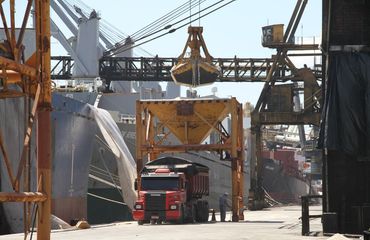
São Paulo – The Port of Paranaguá, in the state of Paraná, finished the implementing of an integrated electronic system to raise the efficiency of the shipping earlier this year. Brazil purchases abroad a good part of the fertiliser it uses in agriculture and about half of it comes through Paraná’s ports. Last year it was around 10 million tonnes and 1.4 million tonnes in the first two months of this year. Among the Arab countries, Oman and Kuwait were the main suppliers this year.
The integrated electronic system was implemented in the public pier in Paranaguá in the exporting of grains and importing of fertilisers. The latter, however, was the last one to be concluded, around sixty days ago, according to the superintendent of the Paranaguá and Antonina Ports Administration (Appa), Luiz Henrique Dividino. With it, there is now a computerised control for the whole process, from the ship schedule to the mooring, incoming and outgoing cargo trucks and emission of receipts.
According to Dividino, previously, each part of the process was dealt with individually, with some steps computerised and some steps manually handled. By becoming paperless there is a reduction of risks, according to the superintendent. He explains that in a port’s operation, from the moment the ship arrives, a number of professionals and companies are involved. A fertiliser cargo from a ship will not usually go to just one company. There are several trucks to transport it. In Paranaguá alone, there are 51 warehouses that handle fertilisers.
That is the reason why the implementation of the new system had to be done slowly, as it involves different parts. The process started in August 2012. With the innovation, the importer can also receive the database in real time and check on the internet what stage of the delivery process his cargo is in. “You reduce the uncertainties”, says Dividino. It is possible to follow the time of all the flux, to know when the truck stayed in each area, how long it took, at what times of day there is more productivity in the port.
Dividino claims the transparency as the biggest advantage, besides the productivity. The system upgrade, which made the terminals more efficient, allowed the expansion of operations in the ports run by Appa. They moved 44 million tonnes in 2012 and 46 million tonnes last year.
According to information by the National Association for the Dissemination of Fertilisers (ANDA), Brazil imported 21.6 million tonnes of fertilisers in 2013. The volume represents 70% of the total commercialized in Brazil in the period. According to Appa, besides Oman and Kuwait, in the first two months of 2014, the Arab countries of Egypt, Qatar, Bahrain, Morocco, Jordan, Saudi Arabia, Lebanon and Tunisia also sent fertilizer cargos to Brazil. Among the ten biggest suppliers, alongside Oman and Kuwait, are Russia, China, Germany, Finland, Israel, Poland, Chile and the US.
*Translated by Rodrigo Mendonça
