


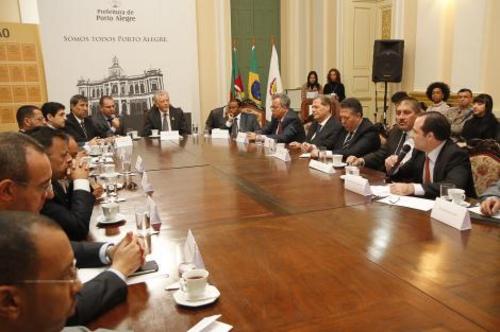
Porto Alegre – The Porto Alegre city hall may be a main player in the generation of closer ties with Arab and Brazilian cities. City mayor José Fortunati met with Arab diplomats on Thursday (16) and showed disposition to organize a meeting between cities in Brazilian and the region. About one month ago, Fortunati was elected president of the National Mayor Front and stated that one of his areas of work will be the generation of closer this between Brazilian cities and others worldwide, among them those in the nations of the Middle East and North Africa.
A group of 15 ambassadors and business attachés of the embassies of these countries is promoting on Thursday and Friday (17) a delegation to the state of Rio Grande do Sul, aiming at improving ties and identifying opportunities for business and partnerships. At the meeting with Fortunati, it was the dean of the Council of Arab Ambassadors, and ambassador of Palestine, Ibrahim Alzeben, who raised the topic of the meeting between cities. The topic had already been discussed between the diplomats and the mayor of Porto Alegre in a previous opportunity.
Fortunati rapidly showed disposition to articulate these closer ties, now as the president of the National Mayor Front. At the meeting with diplomats, he showed interest in the Palestinian cause and said that one of the most gratifying trips he has ever made in his public life was to Palestine. He also recalled that Porto Alegre is a city of plural ethnicity. “What each people has that is important, Porto Alegre has learnt to respect. Here we have peaceful coexistence between the Palestinian and Jewish community,” he said to the ambassadors.
The ambassadors thanked Fortunati for his support to the Palestinian cause and showed themselves available to exchange experiences with Porto Alegre. “Tunisia is living a process of democratisation and is making use of democratic experiences so that it may have a long life in the country,” said the ambassador of Tunisia, Sabri Bachtobji, during his first trip with the group as an ambassador. “The world is a small village and that is why I believe that all your accomplishments will be transferred to the world,” said the ambassador of the Arab League, Bachar Yaghi.
All diplomats made a point of inviting the mayor to visit their countries. The ambassador of Kuwait, Yousef Abdulsamad, said that his government has a minister who cares for the city halls and added that he counts on a visit by Fortunati to Kuwait. When faced with so many invitations, when he asked to speak, the ambassador of Sudan and deputy dean of the Council of Arab Ambassadors, Abd Elghani Elnaim Awad Elkarim, joked: “All of them (the Arabs) have relatives in Sudan, so you can visit Sudan and you will have visited them all.”
Apart from the diplomats, the delegation also includes Arab Brazilian Chamber of Commerce president Marcelo Sallum, the Institutional Relations director, Sylvio Abdallah Jr., and the organisation’s CEO, Michel Alaby.
The group also met governor Tarso Genro (PT), who showed his support to the Palestinian cause. In an interview to ANBA, he strengthened his position. “We are proud to have permanent solidarity relations with the Arab people, in the conflicts related to the Middle East. We defend the right of the Palestinian Authority to full jurisdiction over its territory and this cultural, political and economic exchange politically strengthens a country that fights for peace and greatly respects the Arab community,” he said.
According to Genro, relations with the state of Rio Grande do Sul may advance in several areas. Two of them are agricultural machinery and food, sectors in which there is already commercial exchange. “And on that side we also have extraordinary experiences, not just in agriculture. Specific Arab countries have a chance of transmitting the millenary education that comes from Arab universities,” he said.
Opportunities
The possibility of greater exchange between the state and the Arab world was the theme of seminar “How to Negotiate with the Arab Countries – Opportunities for Trade, Investment and Tourism”, which took place at the Federation of Industries of the State of Rio Grande do Sul (Fiergs) as part of the mission. The Arab countries are the destination for 7.8% of all Rio Grande do Sul exports, a percentage that is above the national total, 6.1%, according to information disclosed by the coordinator of Advisory for Cooperation and International Relations of the state government, Tarson Nuñez.
Rio Grande do Sul had US$ 1.3 billion in export revenues to the Arab world last year, mainly in meats, grain and tobacco, and imports totalled US$ 1.5 billion, with hydrocarbons and fertilizers topping the list. Diplomats and representatives of the public and private sector in Rio Grande do Sul agree that there is good established trade, but that it is possible to increase it, reaching the level of investment and partnerships. “Tramontina, Grendene, Via Uno, Dumond, Marcopolo and Randon are companies that are present in the Arab world, with excellent results,” said Sallum.
The Arab Brazilian Chamber president showed those present the dimension of the market in the region, which, according to him, has a population of over 360 million inhabitants, Gross Domestic Product (GDP) of US$ 2.9 trillion, and bilateral trade of US$ 25.9 billion with Brazil. Rio Grande do Sul, recalled Sallum, is the fourth main trade partner of the Arab countries among the Brazilian states. Alaby stated the different profiles of the region and, hence, the different trade possibilities. “There are rich countries, there are developing countries and there are poor countries. Not all Arab countries are rich and want to export,” he pointed out.
The CEO at the Arab Brazilian Chamber showed which are the main consumer markets in the region – Egypt, Sudan, Algeria, Morocco, Iraq and Saudi Arabia – due to the sizes of their populations, and also spoke about the products the Arabs have to export, beyond oil and fertilizer: olives, dried fruit, medical and hospital material and inputs for the plastic industry, among others. Some diplomats mention examples of partnerships that are taking place in Brazil and the Arab countries, like the presence of petrochemical company Sabic in Campinas, in the interior of São Paulo, and of Brazilian agribusiness group Pinesso, in Sudan. Marcopolo, from Rio Grande do Sul, also has an assembly line in Egypt.
But the order is to exchange more, to come closer, to sell more and to buy more. “We want to increase our relations with the Arab world, not just with exports and imports, but also in partnerships,” said Nuñez. He presented the economic potential of the state to the ambassadors. Rio Grande do Sul, according to Nuñez, is the third Brazilian state in number of companies and the second in industrial GDP, has the second largest petrochemical hub, 60% of rice production and a naval hub with platform production. According to him, one of the strategies of the current government is the internationalisation of companies.
The delegation’s agenda ends on Friday (17) with a visit to bus body maker Marcopolo, in Caxias do Sul. The delegation includes diplomats from Palestine, Sudan, Kuwait, Algeria, Oman, Qatar, Egypt, Lebanon, Morocco, Tunisia, the League of Arab States, Jordan, Mauritania, the United Arab Emirates and Saudi Arabia. The trip is organized by the Council of Arab Ambassadors and the Arab Brazilian Chamber.
*Translated by Mark Ament
