



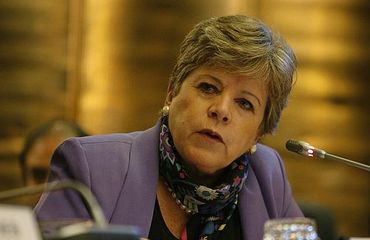
Brasília – The report Social Panorama of Latin America , released this Thursday (22) by the Economic Commission for Latin America and the Caribbean (ECLAC) shows an important reduction in poverty rates in Brazil. According to Laís Abramo, director of the organization’s Social Development Division, more than 2.75 million of Brazilians rose above the poverty and indigent poverty lines in 2014.
“This reduction was sharper among the indigent and this reasonably shows the efficiency and importance of the programs to fight extreme poverty that exists currently in Brazil. We are aware of the economic downturn, with reduction of economic growth, recession and unemployment rise. It’s very probable that there will be negative impacts on poverty and indigent levels. But it will be up to the efficiency of the social protection network installed in the country, to the income transfer programs and to instruments such as the unemployment insurance”, said Abramo.
Alicia Bárcena, executive secretary of ECLAC, said that she sent this Tuesday an open letter to president Dilma Rousseff in which she express her concern with threats to the democratic stability and acknowledges the social and political improvements achieved by Brazil in the last decade. “It harm us that currently, without judgment or evidence, making use of leaks and a media campaign, which holds a strong will to try to destroy your image and legacy, efforts are multiplied to undermine the presidential authority and to end the mandate given to voters in the pools”, she said in a statement.
In all Latin America, between 2014 and 2015, the number of people in situation of poverty grew from 168 million to 175 million, which represents 29.2% of the people of the region. Meanwhile, the number of indigent people, or people in a situation of extreme poverty, went from 70 to 75 million (12.4%).
According to the report, the increase was the result of uneven national results, rising in some countries and falling in a significant number of others. Between 2010 and 2014, for instance, there was a significant increase in the number of poor in Mexico.
The document underscores that in the next 15 years, in the majority of Latin America countries the so called demographic dividend, in which the working-age population grows faster than the dependent population, will remain in effect. Bárcena said that this is a crucial moment for the development of social protection policies and emphasized that special attention will be needed in the healthcare and social security areas, since the negative impact tends to grow.
Another alarming data is that in 2013 one in three women didn’t have their own income or economic autonomy. According to Bárcena, the social exclusion impacts a lot more the women than the men. According to the report, the income of white men is four times higher than that of indigenous women and twice the income of African-descendant women, taking into account the same educational levels.
According to ECLAC, employment is the key to reduce poverty and social inequalities. However, between 2014 and 2015, the unemployment rate in Latin America increased from 6% to 6.6%. The organization advises that efforts to promote decent work, employment formalization and access to social protection mechanisms should persist.
“Spending on education, healthcare and social security should be independent of economic cycles. But, in moments like the current one, of economic downturn, countries should protect the levels of social spending. And, in the periods of growth, increase spending and investments, to reinforce the building of the social protection network”, said Bárcena.
*Translated by Sérgio Kakitani

