



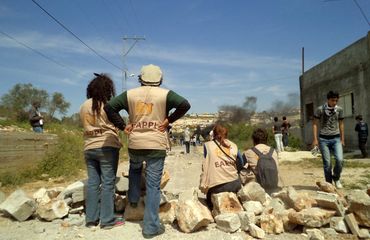
São Paulo – Year after year, groups of Brazilians keep track of the lives of Palestinian people as part of a program of the World Council of Churches (WCC), an international ecumenical organization. This August, ten people have completed their training in São Paulo and are now ready to travel to Palestine, where they’ll keep watch, offer protection to the most vulnerable people, and report any human rights abuses.
The initiative is called the Ecumenical Accompaniment Programme in Palestine and Israel (EAPPI), and was put in place in 2002, shortly after the breakout of the 2nd Intifada – a Palestinian uprising against the Israeli occupation. Around that time, leaders of Christian churches in Jerusalem put out a call for the Christian community around the world to pay attention to what was happening.
The program came as an answer to their plea, and to help protect human rights. Every year, foreigners are brought in to spend three months in Palestine. The WCC was created in 1948 and comprises several Christian churches, including the Orthodox and Lutheran ones. The Catholic Church is an observer member.
EAPPI institutional coordinator Alexandre Quintino explains that the purpose of the program is to “get out there and see the situation, to experience the local reality.” The volunteers picked for the trip go to the West Bank to do three-pronged work. They are to report and document any human rights abuses, to be a protective presence and to build a rapprochement with other organizations active in the region.
Quintino explains that as pertains to human rights uses, the program’s volunteers are often first on the scene, because they have built a broad-enough contact base. When they do, they warn other bodies, such as the United Nations or Doctors Without Borders (MSF). As for being a protective presence, he explains that one EAPPI facility is in Yanun, a small community encircled by settlements. “The simple fact of having non-natives living here gives protection,” he says.
As far as connecting with other locally active organizations, EAPPI volunteers also work in tandem with them to do things like walk children to school – which, by the way, is also a part of protecting the residents.
EAPPI has seven West Bank bases and a reach of 80% of the Palestinian territory. The bases are houses in regular neighborhoods. There usually are 35 EAPPI staff total in the bases at any given time, Quitino explains, with people of different nationalities assigned for each facility.
Brazil started sending in volunteers five years ago. The first ones to travel were Arabic students from the University of São Paulo and members of some churches. Currently, ten Brazilians go each year. The next group has already been selected. December of this year will see the start of another selection process.
Prerequisites
Applicants must speak fluent English, be aged 25 to 70, have prior knowledge of the program, and agree with its principles. Travel and lodging are paid for by the WCC. Quintino explains that most volunteers are young and fresh out of college. Only now did older people start applying. Volunteers from other countries are usually more mature.
The plan is to have people get home and share their experiences through lectures and other means. To mark the fifth anniversary of Brazilian involvement, the EAPPI has organized an exhibition of photos taken by former volunteers. The pictures were shown in São Paulo during the training of the next group, with other showings scheduled for this month in the state of Pernambuco, and next September in Rio Grande do Norte state capital Natal.
In its website, EAPPI claims to espouse a vision of a future in which the occupation of Palestine has ended and both Palestinians and Israelis enjoy a just peace with freedom and security based on international law. It says its mission is to witness life under occupation, engage with local Palestinians and Israelis pursuing a just peace, to change the international community’s involvement in the conflict, urging them to act against injustice in the region.
Find out more:
Eappi (Global): https://www.eappi.org/en
Peapi (Eappi Brazil): https://eappibrasil.wordpress.com/ or https://www.facebook.com/PAEPI-EAPPI-Brasil-473426692696233/ – email: [email protected]
*Translated by Gabriel Pomerancblum
